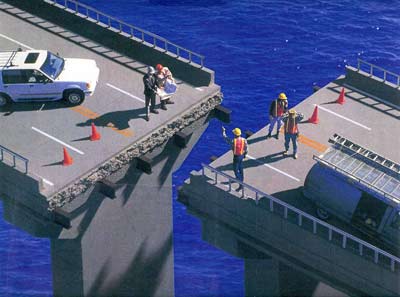
When the tunnel connecting France and England under the English Channel was being dug, they started drilling from both sides. When you start digging from over 50 miles away and the two holes have to line up pretty near perfect, you don’t want as a foreman someone who got a C in Geometry. All kinds of bilingual cuss words would have come out of all kinds of holes. In order to avoid such a disastrous mistake, you need to start from the beginning making sure the trajectory is spot on for the two ends to line up.
I am going to be using all kinds of words which I have recently become familiar, which I will unveil in a moment, that the average reader may not be too familiar with nominally. I assure you, however, your are more familiar in practice with them than you know. You may not be able to recite Newton’s second law of motion, but you demonstrate an intimate knowledge when you put on your seatbelt.
So here are a few paragraphs that contains all the functional vocabulary I will be using.
Eschatology is the study of the last days, eschaton meaning “last” in greek. Your average American evangelical (you know who you are) most likely doesn’t have a very well developed idea of what this looks like or what to expect. However, if you were a betting Baptist (you know who you are) you may say it looks something like a Jerry B. Jenkins and Tim LaHaye Left Behind series. Since the book of Revelation seems to most of us like a fever dream etched by fingernail into the back of a broom closet door, we figure ol’ Tim and Jerry probably got as close as anyone would like to get, so we will take their word for it. I will refer to this eschatology as the Left Behind view, since I think this describes how most Christians today would describe their view, to the extent they understand it.
In this perspective, Christians are suddenly taken away from the earth (raptured) and what follows is seven years of horror, strange diseases, famine, death, antichrists, beasts, dark miracles, with some people left behind still finding Christ, only to then face exquisite persecution, culminating in the return of Jesus and the institution of a thousand year (millennial) reign on the earth and the subjugation of death and all His enemies. There. Now you don’t have to read the series. This view that the last days are in the immediate future of those of us living in 2021, is called a premillennial eschatology, “premillennial” referring to Christ returning before the literal thousand year reign.
On the other side of things are those who think all that stuff in the book of Revelation is best understood as describing the horrors of the Jewish Wars from 66-70 AD, culminating in the destruction of the Temple in Jerusalem, thus ending the Temple Age and beginning the new age, the last days. This view is called “postmillennial,” because it sees us in a figurative thousand year reign of the Christ starting after His resurrection, where the Church, through the Holy Spirit, will effectively Christianize the world, after which Jesus will return and rule over the earth.
In a sentence, the Left Behind viewpoint sees things going from pretty good to bad to a fresh hell on earth, where the postmillennial perspective sees things starting off crappy then successively getting better throughout the ages. Others describe the two as as pessi-millenial and opti-millenial. I will leave it to you to figure out which is which.
Having grown up a good little Baptist boy, I assumed the Left Behind view was true and didn’t even know there were any other options. Any moment now that brassy trumpet will sound and the dead will snap out of their graves like party poppers, and we will look down from our cumulonimbus perch on the judgement rolling out like a scroll on the godless. And we saw it coming too: what else was that mild persecution we experienced in America if not the storm crow of the eschaton?
But endings are such strange things. When you are convinced of them, they change how your live in the present. Ask those who have a hot tip on a late breaking horse, or those diagnosed with pancreatic cancer and a three month expiration date.
My intention here is not to lay a case out for why I believe the postmillennial view point (that the prophecies of John were in his immediate future but our distant past) is true. Though it is something I hope to do more of in the future, here I want to point out a misalignment of the tunnels of the Left Behind viewpoint. I use the phrase “Left Behind viewpoint” to differentiate from a premillennial viewpoint, which is borne from study and conviction of the ned times. The Left Behind view is as an eschatological shanty patched together from pop fiction, unchecked assumptions and whatever other pieces of broken prophecies that may have been dug up.
A strong emphasis in evangelical America is placed on the Great Commission found in Matthew:
All authority in heaven and on earth has been given to me. Therefore go and make disciples of all nations, baptizing them in the name of the Father and of the Son and of the Holy Spirit, and teaching them to obey everything I have commanded you.
Matthew 28:18-20
We are commissioned with this message to go and change lives with the Gospel. We disciple them, meaning the convert continues to grow in their understanding of God and how he ought to live in this world. This changes how he loves his wife, how he parents his kids, his work ethic, how he votes, speaks, recreates, and what he does on Sundays. This person is then commissioned to make disciples of others who would undergo the same changes.
Evangelicals dream, pray and work toward this mossy green multiplication. I mean, it’s in the name evangelical, from euangelion, greek for “good news.” We have whole classes in church on this. This viewpoint is so pervasive in the evangelical world you would think that, as we multiply disciples whose lives are subsequently changed, we would expect our world would do nothing but get better and better! Just think of all those new Christians, gleaming in their ranks of thousands and millions! Our world would be changed! You would have more Christians making families, stabilizing cities, voting, running for office, starting businesses, championing non-profits, funding overseas missions, rooting out oppression and sin – how can things not get better!
You would think so. But no. Strangely, along with this missional direction which has world change at its core, you find the parallel assumption, streaming from a Left Behind viewpoint, that things are going to continue to get worse, governments more oppressive, abundance turing to scarcity, persecutions multiplying, sin festering, shadows lengthening, the church withering on the vine until only a remnant remains, whom the Lord Jesus, perhaps in his pity, will scoop up, finger us around his palm, and Superman it back to heaven.
You see, they don’t seem to line up as they should.
Are we working against ourselves? In the right hand we believe in the power of the gospel to change lives and terraform our world. In the left, we are digging in for the worst.
This has many effects. Knowing the ending, as we think we do, changes how we act in the present. Supreme court legalizing gay marriage? This must happen for the end to come. Increasing murder rates in Chicago? It’s going to burn anyway. Babies murdered by the millions? Wickedness will increase; Bible says so. Earth choking pollution? We got a new one coming in the mail! Government printing money? Boom, one world currency. Christians being kicked off social media? So that’s what it feels like to be a martyr. It’s about time, we say, these things must happen for the end to come.
And so we do not fight it, we do not raise our voice, we do not tie ourselves to the earth and say “thus far and no farther.” Not only have we assumed a certain end, the assumption doesn’t line up with the the fundamental mission of our faith. I daresay it contradicts it.
A postmillennial perspective lines right up with the commission of Christ and is painted a cheery yellow. As bad as things may be, the final result is the earth, this physical earth that we occupy, filled with the knowledge of the Lord as the waters cover the sea. This will happen through the Church, through your church, through you. If you know the end is victory for the church, then your attitude when surrounded by darkness should not be “there is so much of the enemy how could I possibly win?” but “there is so much of the enemy how could I possibly miss?”
Our Left Behind assumptions themselves should be left behind. Much ground has been lost from the retreat mentality which underpins this eschatology. Territory that was fought for and won has been abandoned because the world came along and hurt our feelings, which we took as a sign of the times. And it certainly is, in a manner of speaking.

 Thought Butter