Introduction
In the early eighties a strange virus ghosted into America. It started killing off young men mostly, and did so slowly. They began presenting with symptoms of rare diseases and opportunistic infections which were largely foreign to that demographic. It seemed to be targeting homosexual men and those who were sexually active. No one knew how you got it, or more importantly, how to avoid it. The disease was human immunodeficiency virus, HIV. Once this disease progressed to its terminus, it presented in a cluster of symptoms which we call an acquired immunodeficiency syndrome, or AIDS.

Though not as gruesome as the bubonic plague or terrifying as the ebola virus, the insidiousness with which HIV quietly knocks out the body’s defense mechanisms gives it the eerie efficiency of a silent assassin. It hides in cells, causes no symptoms of its own, and can hibernate for years before manifesting itself. Unlike a bacteria, HIV lacks the tools to self-replicate and instead uses the machinery of the host to manufacture more of itself. Perhaps this is the most insidious aspect of it: your body helps it kill you.
It will not use just any cell, but specific immune cells called CD4 T-cells. CD4 T- cells are a particular type of white blood cell which do not fight pathogens directly, but mobilize other white blood cells to destroy pathogens. They are like battalion commanders who strategically direct their forces in battle, but don’t engage the enemy directly. If enough of these commander CD4 cells are neutralized, the body is unable to mount a response to pathogens. The troops, though armed and deadly, are on standby. HIV cannot actively kill the body by overwhelming destruction of host tissues like Ebola or Hantavirus, rather it weakens the immune system by targeting these immune commanders. Once the body’s ability to mount an immune response is incapacitated, opportunistic infections and even normally benign illnesses such as the common cold can kill the host.
The body of the United States has been under a similar viral attack. No, not Covid. It is a virus which understands it could never overcome the culture with a direct attack and has instead strategized to target the culture’s immune system. Once the defense mechanisms of a culture are sufficiently weakened, the protective mechanisms neutralized, the body will be vulnerable to the second attack. There is a cultural immunodeficiency virus (CIV) infecting the root of the institutions of America.
What I would like to do is a bit of ideological epidemiology and trace CIV from its origins in Karl Marx, Antonio Gramsci and the Frankfurt School, and discuss the pathophysiology of the disease on American culture. Ultimately, my goal is to give some thoughts on how the church in America ought to position herself towards critical theory and its specific virulent form, critical race theory. Seeing as how there needs to be a fair amount of groundwork laid, this post will be focused on understanding the philosophies and ideas which have led to where we are today. After laying this foundation, I will have some purchase from which to discuss thoughts on a response from a Christian perspective.
Marx
Thomas Sowell said the word racism is like ketchup…it goes on everything. Marxism is subject to similar overuse. In conservative circles, there is a revulsion to communist ideology or anything that smells like it, so the name “Marxist” can be a stand-in for ideas which are generally left leaning, though not necessarily Marxist per se. It is used to castigate a person as anti-freedom, anti-American. This can be unhelpful when we want to really understand an idea without all the leaf litter of propaganda covering it up.

Karl Marx was a revolutionary, and like all revolutionaries, he was chasing a utopia. Somewhere over the rainbow, above the gloomy clouds of oppressive capitalism, was a communistic paradise where all goods were shared and equality ruled. The nasty parts of communism – the seizing of means of production, abolition of private property, etc. – were the thunderhead which necessarily precedes the rainbow. Most bios on YouTube of Marx are not flattering. But to be fair, he wasn’t brooding in a dark room scheming how to make the world more a horrible place on purpose. His intention in writing the Communist Manifesto was to bring to an end what he saw as gross injustice and give power to the oppressed.
Now, just so happens the outworkings of his ideas do make the world a more horrible place, which is the causative effect when you advocate grand larceny on a global scale, freeload off society, philander with the maid and abandon the subsequent child. So the character attacks are not unjustified.
In order to understand how Marx plays into CIV, we need to understand one concept which Marx erected his theories upon, the dialectic. Gleaned from philosopher Hegel, the dialectic is the view that all history precedes through conflict. Hegel, being notoriously hard to read, said all history can be reduced to a cycle of perpetual conflicts between a thesis (a given state of circumstances) and its antithesis (the contradiction or negation of the circumstances) which is resolved into a new synthesis (some sort of compromise which reduces tension). Hegel did not use these terms exactly, but instead chose the much more obfuscating words “abstract-negative-concrete” to make his point. See, it’s almost like he is trying to sound pedantic.
Hegel’s dialectic worked like this, taken from a real life example from my own life:
- Thesis: build a new deck in place of the crappy one on my house
- Antithesis: keep the old, crappily built deck in place
- Synthesis: renovate the existing crappy deck to make it less crappy.
(Turns out I went for the thesis option, but you get the point).
Marx knew Hegel was right but thought his expression of the dialectic was too ideological, too impractical. It needed legs and boots on the ground. So he applied the dialectic to economics, with his dialectical materialism, which is the super power ranger name for viewing all history as a class fight over limited resources. Since there are limited resources, Marx reasoned, and since we all want the resources, conflict is inevitable.
For example, if a wealthy manager (thesis) is exploiting his wage laborers (antithesis) the conflict between the two, say, a strike of the laborers, may result in a dollar an hour raise (synthesis). This synthesis will inevitably become a new thesis against which a new antithesis will arise, resulting in yet a new synthesis, and so on. Marx saw society in terms of classist power struggles split up into two camps – and this is key – the oppressors and the oppressed, and it is this cycle of social conflict over limited resources which turns the waterwheel of history. Dialectic is also called conflict theory for this reason, because it sets class conflict as the main instigator of any and all societal change.
Writing during the industrial revolution, Marx saw the economic disparity growing between the wage laborers and factory owners and capitalism was the economic system through which this oppression persisted. The rich, or bourgeoisie, owned all the means of production and paid the wage laborer, the proletariat, just enough to keep him happy, and sometimes not even that. The rich exploited the poor and the poor worked to perpetuate the exploitation. The proletariat, though they were the ones actually doing the work, did not harvest the profits. He saw this as a fundamental injustice built into the capitalistic system.
Not only did the bourgeoisie own the factories and commodities, but also had the political clout to arrange society according to their values and goals, while keeping the proletariat fighting over the scraps that fell from their tables. His goal was to wake up the proletariat to the reality that they were the ones doing all the work while the fat cats get fatter, and there are more of them than there were bourgeoisie. Once the proletariat became aware of the unjust, mustache-twisting schemes of the bourgeoisie, they would rise up and seize the means of production, breaking the back of capitalism and ending oppression. The means of production would finally be in the hands of the working class where it belonged and the world would be one step closer to the utopian vision of communism. The dialectic was ripening; the antithesis beginning to simmer. Communism was inevitable.
But the inevitable didn’t happen. There were a few countries in Marx’s day that seemed to follow this train of history, such as Russia, but largely Marx’s ideas didn’t materialize. The means of production stayed in the soft palms of the rich. Why? Many of Marx’s disciples were baffled.
Gramsci
Amongst the disaffected was one of the progenitors of CIV, Antonio Gramsci – an Italian Marxist philosopher and linguist. Gramsci was a tiny little hunchback of a man, being disfigured by a childhood illness, but he was intelligent and handy with a quill.

A rising star in the Communist party of Italy, he was leapfrogging into leadership a decade after college. At the same time, Benito Mussolini, with his chin that was just begging to be punched, was rising to prominence in the Italian Fascist party. Communism and Fascism were not simpatico with one another, and after an attempt was made on Mussolini’s life the Fascist party enacted emergency laws, which I am sure were fair and well thought through. Gramsci, now the leader of the commnunist party, was tossed into the slammer.
During Gramsci’s trial, the prosecuting attorney said, “For twenty years we need to stop his brain from functioning” and sentenced him to a couple of decades behind bars.
Well that didn’t work. He wrote proliferously while imprisoned and his works were compiled into a compendium entitled Quaderni del Carcere – The Prison Notebooks. (As a point of interest, the first translation into English was in 1971 by Joseph Buttegeig, father of current Secretary of Transportation and 2020 presidential candidate, Pete Buttigieg.)
What puzzled Gramsci was why this dialectical materialism which Marx was so certain of did not occur? The proletariat, instead of throwing off their bourgeoisie oppressors, nestled down into capitalism which was actively oppressing them. What could cause this comatose attitude towards classism which was obviously not in their best interest?
Gramsci concluded the power of the ruling class was impervious to revolution which Marx prescribed. This is because their power was protected and enshrined in social structures he called the hegemony and passed down to subsequent generations through traditions. Gramsci identified these institutions as the family, the church, law, education and media. Through these institutions the ruling class passed along the hegemonic scepter to safeguard its power over the working class and preserve the status quo. These structures which strongly favored the rich, were too strong and incumbent in a culture to be overthrown by revolution. In order for Marxist ideas to infiltrate the bourgeoisie culture and bring about the revolution hoped for, Gramsci concluded that these power structures must first be weakened.
It is important to note here that Gramsci is not wrong about these pillars of society; they are the institutions which safeguard culture. The family, church and education are God’s design for passing truth and goodness onto future generations. The law is the expression of how to protect these values, and the media artistically expresses these values. He identified the immune system with amazing perspicacity – but for the purpose of destroying it.
In the transmission from Marx to Gramsci, an important mutation developed in the virus. Marx was concerned with controlling the means of economic production – who controlled what resources and how they use these resources to consolidate power to themselves. Gramsci saw the greater battle was controlling the cultural means of production – who was controlling the five pillars of society and how they were using them to retain cultural dominance. Marx had recognized the connection between the laws and social structures noting, “the ruling ideas of each age have forever been the ideas of the ruling class” (Communist Manifesto, p 86). He did not, however, see these ideas of the ruling class to be as much of a bastion as Gramsci, who rightly recognized them as the key that would unlock the door that Marx had failed to force open.
Cultural hegemony is the unifying theme of Gramsci’s philosophy – that man is not ruled by force alone but by ideas, and these ideas are cemented into the zeitgeist of a culture through the institutions making them impervious to revolution. As far as Gramsci is concerned, all of culture is merely a collection of bourgeois values. This is an important concept that must be understood if we are to understand our society in 21st century America. The oppression which breeds inequality, injustice and slavery of the lower class, is preserved in a society through the culture of the ruling class. The injustice is greater and more replete than consigned to the economic sector; it infuses all parts.
This reminds me of a game we used to play when we were kids called Four Square. A large square was divided into four equal squares, numbered one through four, and a ball was bounced between the players according to certain rules. The goal was to work your way up from the first to the fourth square by knocking out those in the square higher than yours and moving up. Once you worked your way into the top square, you had the ability to change the rules of the game, allowing certain moves, outlawing others, whatever was in your own best interest to maintain your position in the top square. Gramsci saw the bourgeoisie as incumbent in the top square and made all the rules act in their favor.
The hegemony was an abusive husband which coerced but still provided for the wife he beat on. But since the proletariat was a larger mass of people, the bourgeoisies knew they needed to give them at least the appearance of consent to keep them happy and quiet. The proletariat could not see they were imprisoned to ideas not of their own making, which were not in their best interest. And “in order to achieve a revolutionary perspective, the workers must first be freed from the ideological fetters imposed on [them] by the cultural organizations of the ruling class” (Bates, 1975).
As a means to shatter these ideological fetters, “Gramsci’s principle,” French journalist Jean-François Revel explained, “was that [communists] must begin by influencing the culture, winning the intellectuals, the teachers, implanting itself in the press, the media, the publishing houses.” Any of this starting to sound familiar? This was to be done by “organic intellectuals”, those who can articulate through the language of culture and arts what the proletariat wanted to but was unable to say.
Here is where CIV originates: the cultural body is too strong; an overt attack will be resisted because of hegemonic immune functions acting to maintain its power, the status quo. The strategy must change. Instead of a swift Marxian revolution resulting in an overnight power shift, this slower, methodical approach, targeting specific pillars of society, will weaken the hegemony and allow the communistic revolution to finally prevail. This strategy was described by communist Rudi Dutschke as the “long march through the institutions.” Once CIV has weakened the country, there will exist no more unifying structures by which it’s people can resist revolution. As HIV targets immune cells of the body, Gramsci targets the immune system of culture.
But there still exists the problem of how a virus can enter the body in the first place, and then get to the business of replication. With CIV, this strategy took shape, as all really bad ideas do, with a group of intellectuals – the Frankfurt School.
Transatlantic Transmission
Three years prior to Gramsci’s imprisonment, several Marxists scholars coalesced to form the Frankfurt School in Frankfurt, Germany. Like Gramsci, they had become disenfranchised after the Marxian revolution failed to deliver like expected.
True to Marxist form, they saw society through the suspiciously binary oppressed and oppressor categories. In the early 1920s radio and cinema were burgeoning technologies and for the first time culture was able to be mass-produced. People would be hypnotized and sit passively before the cultural content pouring in over the radio waves instead of engaging in it. It would be easy for mass-produced ideologies to lull the masses to sleep to the tune of capitalism and the oppression therein. Not only did they have to live in the world where their labor was exploited, now they were going to be importing it into their homes on their time off. The intention of the Frankfurt School was to offer a critique of society, identify pathologies within, and explore the possibilities of social emancipation from capitalistic burdens. In 1933, prior to the onset of World War 2, they were kicked out of Germany and took root in New York in what is now Columbia University.
The Frankfurt School is known for developing Critical Theory. Understanding the goal of critical theory is vital to gaining a clear picture of how and why CIV attacks social structures as it does.
In an essay entitled Traditional and Critical Theory, Max Horkheimer compared traditional theories to critical theories. Traditional theories, such as the theory of electromagnetism and general relativity, seek to understand what is objectively true based on repeated observation. Critical theories, however, believe that the assumed truth of a culture is inextricably embedded in a social structure and historical context where truth and power are intertwined; impartiality of truth is impossible. In other words, critical theory isn’t interested in how and why electromagnetism works, it is interested in how the status quo of classism is perpetuated by electromagnetism becoming true; electromagnetism is “true” because it behooved certain people that it be true. It may be objectively true, it may not be – critical theory is uninterested in this. Truth is that which provides a kickback for the powerful.
Think for a moment about what this does to our understanding of truth. Let your eyes adjust to the dark. Just as Gramsci saw all culture as an expression of bourgeoisie values, critical theory sees all truth as the sum total expression of the oppressor’s values. Critical theory’s vision is to reveal this truth and free the oppressed from this false vision. How much would we have to drill that cavity to get out all the decay? The answer is all the way to the bottom. Critical theory is America’s root canal.
For this reason, critical theory is far reaching. If you were to think about all the truths America is built on, and then introduce the idea that all of those assumed truths but tools to prop up the powerful on the back of the oppressed, then its open season on any and all established truth, cultural norms or societal values. Everything must be called into question and interrogated through a lens of oppression and the injustice it breeds. Painfully, this also applies to any tool that one might use to evaluate a truth claim, such as reason and logic – tools which themselves must be subject to the scrutiny of critical theory.
In summary, the tools that build the accepted truths of a society only build structures that house the elite. This knowledge is used to establish a hegemonic structure which maintains a status quo. Because of this, critical theory does not critique any specific aspect of society, but the whole thing; the yeast of the elite has worked through the whole lump. Everything must be questioned, especially those nice juicy power structures which Gramsci pointed out.
Both Gramsci and the Frankfurt school observed the same phenomena and formulated complimentary attack vectors. Though they were not intentionally working in conjunction, Gramsci identified where to attack – the hegemony – and the Frankfurt School devised the how – critical theory.
Introduction of Disease and Progression
Before a disease can begin causing havoc to a body, there is the problem of getting into the body in the first place. Oftentimes, pathogens are introduced through a weakness in the body’s defenses, such as a skin abrasion or through an unsuspecting mucous membrane. CIV entered America through a gaping wound in her history: racial based slavery.
Tracing the epidemiology of this disease in America most certainly starts where real oppression existed, among African Americans, which persisted long after slavery ended. Jim Crow laws stretched its arms over a century of American life and were not abolished until the late 1960s. Even after their abolishment explicitly biased laws lingered on some books. There really was a prejudicial function in America which loitered in the blind spots (or not so blind) of a mostly white population and kept blacks economically and socially anemic.
Thankfully, such oppressive institutions and systemic prejudices have been weeded out through confession, legal precedence and the brave marches by reformers such as Martin Luther King Jr, W.E.B. Dubois, Rosa Parks and many others. I realize I am assuming and not proving the dissolution of widespread racism in America, a topic that is hotly debated. I will not take the time to do this here since the focus of this piece is on the disease progression of Marxist thought in America.
Even after major legal victories during the civil rights movement such as Brown v Board of education (1954), the Civil Rights Acts, and the Voting Rights Act, some blacks still cast a cautious and untrusting eye on the legal system. They did not believe racism was defeated, but had just gone underground. The unjust treatment of the black race was no longer a monolithic giant, ugly and obvious to all, but instead it was scattered into a thousand smaller pieces and hid in innocuous laws and rules and business practices in our legal system which was manufactured to favor whites and oppress blacks. Therefore, the legal system in America needed to be approached from the only perspective that could uncover the true reason behind its motivation – a critical perspective. This became known as critical legal theory.
Since all laws are nothing more than the moral expression of a culture, this must mean the oppression which manifests in the legal system was a derivative of the wider culture. So not only in the legal system, but in all aspects of culture from education to cultural norms to healthcare to the workforce, a black person is oppressed by virtue of their skin and a white man benefits from his whiteness. Here the most wicked form of oppression had finally reared its greasy head. It was oppression which wasn’t distinguished by wealth or social class, but the immutable characteristic of skin color. This is bigger than critical legal theory, it is critical race theory.
If you haven’t heard of Critical Race Theory (CRT), then happy birthday and I hope your time in the womb was cozy. CRT is a virulent strain of the cultural immunodeficiency virus which has targeted America based on her genetic historical makeup. It is critical theory genetically enhanced to infect America.
CRT is the love child of critical theory and Gramsci’s hegemony. It combines critical theory’s assumptions of power based truth and Gramsci’s power enshrinement in cultural pillars. It adds to this genetic mashup the assumption that race is the dividing line along which the oppressor and oppressed has been drawn. White people benefit from the privileges baked into the system. White supremacy is mixed into the concrete foundation of America and every white person is an unconscious beneficiary of that system. Whiteness is connected with power and power is connected with systems of whiteness that are embedded in every institution of American life. It is inescapable and inextricable. We could no more remove the white preference in America than extract the eggs from a baked cake. The only thing to be done then is to toss the whole cake. That is the assumption and intention of critical race theory: if justice will prevail, it will not do so in the current system.
But CRT did not stop at race. Since American hegemony is not only white, but also Christian, male, straight, etc., then the oppressed are not only blacks but female, non-Christian, non-straight, etc. Inequality and oppression extends beyond mere race based distinctions to include all those who fall outside the slender boundaries of “normal”. The system is set up to oppress them as well.
As both Marx and Gramsci learned, the oppressed tend not to rise up on their own. They need provocation. They must first be incentivized with suffering; for some kindly chap to open their eyes to how bad they have got it, how things really aren’t going all that well for them after all. Since the Marxian ideals require an oppressed class in order to progress, sometimes this oppression must be manufactured. This has been achieved in intersectionality, a term coined in the late eighties by black feminist Kimberle Crenshaw.
Intersectionality has travelled miles from where it began and is nearly unrecognizable even to its mother. Crenshaw wrote a paper in the eighties commenting on three legal cases where black women were discriminated against. She believed the discrimination of a person who is black and female should be approached differently than if the person were black or female, each identity carrying with it its own unique oppressive burden. Such was the definition of her term. It has since been turned up to eleven.
Today, intersectionality is the sum of the differences an individual has from the hegemonic culture. For example, in America, the defender of hegemony is a straight, white, male, Christian in a nuclear family. If a person is a black, gay male, the intersecting identities creates a unique distance from the hegemony. A bisexual, transgendered person, native American would have a greater number of intersectional identities and therefore more surface area for oppression. What this does is it expands the catchment area of the community which can be built around oppression and claim a unique bouquet arrangement of discrimination. Intersectionality now has a life of its own, having no limiting principles. The concept of gender alone has fractured into innumerable shards, the growing list of sexual peccadilloes expands, and with points of personal preference as numerous and unapproachable as the twinkling stars above.
Now, by definition, all of these individuals with their varying levels of intersectionality are an island unto themselves. Intersectionality is nothing if not demarcating one’s own personal story of suffocating under the injustice of established American norms. However, these individuals have found solidarity in being part of the collective “community” of oppressed groups. Regardless of the combination of their unique intersectional makeup, they all share the common experience of victimization by the hegemonic class. Et voila, we have ourselves a new oppressed class, one not based on wage laboring, or racial slavery, but one of cultural oppression, where they are impounded to the culture of white, Christian, straight men. Not one “identity” on its own would have the numbers to challenge the incumbent hegemony, but the confluence of all is a vast number.
Attacking the Immune System
The insidiousness of HIV is that it weakens the immune system so even a common cold can destroy the body. The insidiousness of CIV is that it destroys the immune system so the body attacks and destroys itself. There is a sort of autoimmune function where the body sees itself as the enemy and the only true course of action is its destruction.
Gramsci stated “The awareness of being part of a definite hegemonic force…is the first step towards a progressively higher self consciousness…” The term “woke” has been used as an indicator to society that a member of the ruling class (white, straight, male) had awakened to their membership of that ruling class, a sort of dark confession acknowledging their unwitting complicity in adding to the grievances of the oppressed. They have become aware they have been beneficiaries of certain benefits afforded by their membership of the ruling class – white privilege – which intersectional individuals have not been privy to.
Wokeness is the agreement of the ruling class that the hegemony has to go. You may have seen white celebrities looking misty eyed into a camera and saying I am part of the problem, like a black lab that got caught nosing through the trash. In Gramscian terms, these white folk (shall we call them Gram-crackers? – yes we shall) realize they indeed have been undeserving beneficiaries of this system and need to actively dismantle those areas where they have passed down their values. So not only is there the mass of intersectional identities which see hegemony as archaic and oppressive, the hegemony is also auto phagocytizing itself.
What this means is that there is a fire sale on the established truth of a culture: everything must go. Anything which was built under the hegemony is, by definition, built on the back of the oppressed, and exists to perpetuate its own existence, reap what it did not sow and gather where they did not scatter. The current system cannot be used to fix the system – the system itself must go, or as Audre Lorde put it, “The master’s tools will never dismantle the master’s house.”
Praxis
In critical theory newspeak, praxis is the convergence of theory and practice, or in other words, praxis is activism. As I near the end, I want to give a few examples of how CIV has infected the immune system of America in the five areas Gramsci identified. This will not be exhaustive in the least – books have been written on each of these. But it is important to see the effects of this disease in the body politic today, and see that it is connected to old thoughts and ideas.
Remember, viruses must use the machinery of the body to propagate itself. It cannot live on its own. Cultural immunodeficiency virus also does not want to destroy the body, but get inside and make it a machine to churn out more of itself. Viruses have no limiting principles and will continue to propagate. The point of the virus is to make more virus. It is a weed that will suffer no flowers but its own to bloom.
In the new order, Socialism will triumph by first capturing the culture via infiltration of schools, universities, churches and the media by transforming the consciousness of society.
Antonio Gramsci
Education
Education is the systematic passing down of learning to the next generation, building on previous insights and discoveries, along with the accumulated knowledge and understanding of the past. In America, this includes the founding of the country on principles of freedom and equality. CIV is attacking this education specifically by targeting the founding. The 1619 Project is a series of essays released by the New York Times which resolves to change the founding of America from 1776, when the colonies declared independence from Britain, to 1619, the year the first black slaves arrived in the New World, asserting the history of America was built on the subjugation of blacks. What this means is that any educational structure which was built on foundational principles must be razed.
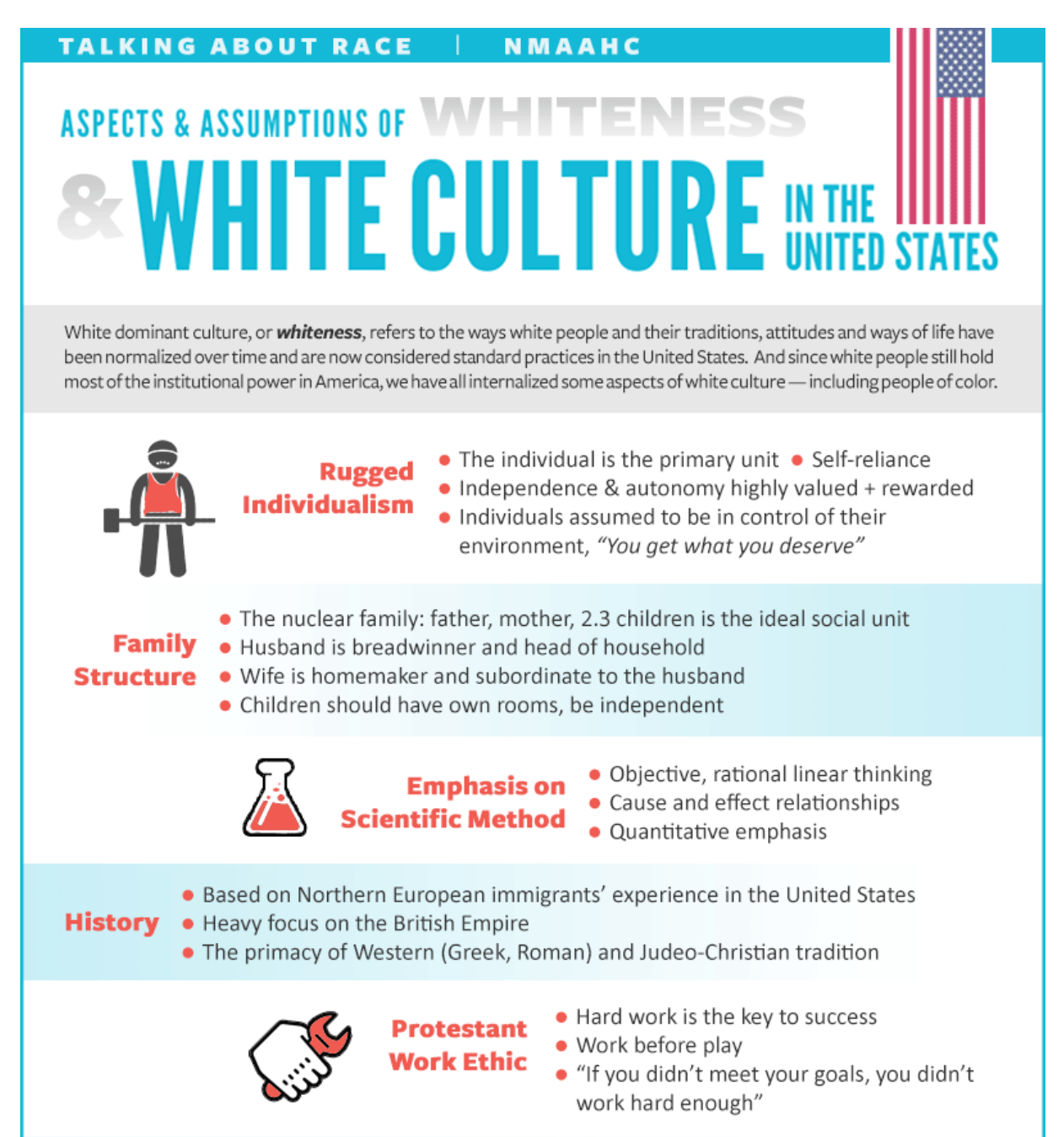
Remember, critical theory is a fire sale, everything must go. This includes applying CT to all of the areas of study which have been furthered under the “oppressive hegemony” – math, biology, chemistry, agriculture, et al., and I do mean et al. How has chemistry been developed to oppress certain people groups? I don’t know, but we can assume it has been because the current assumed truths of chemistry were accepted by a culture built on oppression, and therefore calls for a Critical Theory of Chemistry, or whatever. A few months back there was a concerted effort by some woke mathematicians to come up with a legitimate rebuttal to the established truth that 2+2=4. The Smithsonian released a graphic identifying “The Assumptions of Whiteness and White Culture in the United States.” On this list was the “emphasis on the scientific method”, “objective, linear thinking”, and “cause and effect relationships.”
Government schools get forty hours a week alone with kids’ brains. The ratio of progressive to conservatives professors in higher education has increased 350% since 1984 (Shields, 2018) and a study from Econ journal in 2016 shows a ration of 12:1 progressive to conservative in general, increasing to 33:1 in humanities such as history and literature (Langbert, Quain an Klein, 2016). There is no indication this ratio will lessen.
Media
This one will be quick. That mainstream media is not merely leaning left, but yanking the country leftward, is evident. Transgender story hour at local libraries have lines of moms, woke to the gills, pushing strollers with gender-TBD children waiting to glisten with righteousness. Nickelodeon and Disney are writing characters who are transgender, queer, gay, etc. Netflix just released a cartoon series called Q-Force, which has the synopsis, “A gay superspy and his scrappy LGBTQ squad fight to prove themselves to the agency that underestimated them.” That the media has been infected with critical theory is an understatement. Only 7% of White House journalists self-identify as conservative, and that was almost a decade ago (Cillizza, 2014). Books challenging intersectional identities are pulled from libraries and shelves based on the scantiest complaints (Goins-Phillips, 2021). It is the active purveyor of the disease Media is the tongue of a nation and “the tongue is a small part of the body, but it makes great boasts. Consider what a great forest is set on fire by a small spark.” James 3:5. This pillar is by far the most diseased, irrevocably so, and if there were a doctor present, he would recommend amputation.
TIme defies me to mention all the instances of people being “cancelled” from social media and , indeed, culture in general for minor infractions, perceived insensitivities, or way past indiscretions. Ours has rightly been deemed a “cancel culture”.
Law
As mentioned above, critical race theory is an offshoot of critical legal theory which viewed the American legal system with the baseline assumption that it was set up to be discriminatory against certain classes and races, with hidden interests and unconscious biases underwritings the legal code in America. Taking a critical view of the legal system during the 60’s was not unfounded and did have some legitimate claims. Critical theory collapses the world and its complex interactions into two categories, the oppressed and oppressor, meaning guilt and innocence is reduced, not to determine who broke the law, but which party is being oppressed by the other. As an example, when the #metoo movement was trending, it came along with the expectation to believe all women. Due process was effectively disabled. The foundation of this belief is that women are weaker, sexually oppressed and it would therefore be unfair if both the alleged male perpetrator and the victim’s voice were given equal weight in court. Oppression equals truth.
Furthermore, critical theory sees the entire structure of the legal system as unfairly targeting people of oppressed classes. As critical theory in the law progressed, what grew out from it is a sense of right and wrong based on a person’s intersectional oppression. Increasingly guilt or innocence is decided upon in the court of public opinion, the media being the megaphone for fringe voices, which only requires the skin color of the defendant and plaintiff in order to determine a verdict. When a black man is convicted of a crime it is because of the inherent biases in the legal system. When a court rules in the favor of the white guy, it does so because it is rigged in such a way. Reducing the complexities and nuances of legal cases to a sole determining factor of class distinction is the advent of a new kind of legal code which does away with due process, the necessity of witnesses, and even the abolishing of protections of private property.
Attempts of states to place restrictions on abortions, even “modest” ones, are immediately attacked on the platform of them being racist and sexist, making it a constitutional issue under the Fourteenth Amendment.
Family
The family is the structural unit which builds civilization. The relationship between parents, and parents and their children are the most integral relationships in the human experience. Family traditions are primary means by which cultural values are passed down to future generations. GK CHesterton says of tradition, “Tradition means giving votes to the most obscure of all classes, our ancestors. It is the democracy of the dead. Tradition refuses to submit to the small and arrogant oligarchy of those who merely happen to be walking about.”
The nuclear family has been demonized as a remnant power structure which oppresses alternative gay, transgender or queer lifestyles. Marriage can be between two women, two men, or a “birthing person” and a “man who menstruates” – and I did not invent these terms, just reporting. This particular hegemonic pillar is fairly impervious to critical theory and therefore has been attacked by several indirect means. Government education has rewritten, for example, what constitutes traditional sexuality, teaching strange concepts such as the gender unicorn in classrooms, serving up a heaping pile of pig suey to serve the nation’s children, who then take this into the home. Legal action has been taken against parents who refuse to allow their elementary school child to change his or her gender. The child becomes a refugee and finds welcoming open arms in the transgender “community”. What results is the child finding refuge in friends and institutions which verify his feelings and becoming an alternate family. Critical theory challenges traditional family and makes orphans of the children of the country to be adopted into the family by the cultural collective which will be the means of passing down a brave, new tradition to posterity.
Again, the Smithsonian graphic identifies as a race issue the nuclear family: father, mother, children. The Smithsonian is funded by the US government.
Indirectly, women’s liberation and feminism, by breaking free from the patriarchal and hegemonic family unit, has contributed to the absence of fathers in the home, decapitating the family’s head. The result of this experiment of achieving “equality” by relieving fathers of their responsibility has been an astronomical rise in crime, poverty and poor education.
It is not as important that the family be broken in any particular way, only that it be weakened by any means possible. So introducing division via the children through intriguing new social ideas, through the mother via encouragement of self-reliance and incentivizing single parenthood, or men through severing their ties to their future via relinquishing them of their fatherly responsibilities, the goal of weakening this pillar is achieved.
Religion
“Socialism is exactly the religion which must overwhelm Chrisitainity.” Gramsci had a much higher opinion of Christianity than most mainstream evangelical Americans, I daresay. He saw the importance of the church’s role in passing down a system of values, and indeed, the church does have a crucial role.
As the church is the body of Christ and God’s instrument in this world to bring his kingdom and disciple nations, the enfeeblement of this pillar by CIV is particularly devastating. A century of softening backbones and an abundance of the hybrid spiritual fruit of Niceness has opened the front door of the church to the vampiric intentions of critical theory. With the church infected, it removes the greatest bastion against CIV while creating the most efficient delivery mechanism for the ideology possible.
The hoodwinking has come mostly through the faulty assumptions that critical theory is after similar goals as the church, which is to bring equality, justice and blessing to our community and country. We are mistaken about this. What we thought was a partnership with worldly institutions based on common grace was actually inviting into the front door the assassin who had the church as a prime mark. In a future post, I hope to show specifically how the church has invited CIV into its body, why this was foolhardy, and what we should be doing about it.
Since these five pillars of society, or the immune system of the body politic as I call them, were actively used to promote social oppression, then there needs to be justice applied on the social level – a social justice.
Conclusion
We have traced the roots of critical theory through time, with its inception in the fundamental assumptions of Marx that all of history is conflict and oppression. When this conflict did result in the toppling of the capitalistic machine as Marx thought, Gramsci and the Frankfurt School reasoned this was because the culture provided a capsid of protection for the ruling class through the means of manufacturing culture which perpetuated their rule. Controlling the means of economic production was secondary to controlling the means of cultural production. As real oppression entered America through race based slavery, critical theory called for the critiquing of all areas of culture through an oppressive lens. From there critical race theory took over and prophesied that the racism which defines America did not go away in the civil rights movement but embedded itself deeper and in subtle ways, creating a permanent oppressed class in blacks. Intersectionality augmented this oppression to include any identity of a person which differed from the hegemony, creating a metastatic network of widespread grievance. We have arrived at our current day where cultural immunodeficiency virus is busy knocking out the structures of American culture, and has eaten through most of the way.
Much has changed since Marx initially laid down his ideas of conflict theory and dialectical materialism, it is important to see the common throughline to present day. There are only two types of people, bourgeoisie and the proletariat, but now we refer to them as white, cisgendered men and the intersectional. The desire for utopia is just as strong and the resolve for social justice is as revolutionary as it was 150 years ago, though more sophisticated. There is no parle possible with CIV, any more so than there can be with a virus rewiring your DNA. It has no limiting principles.
I wanted to provide a 30,0000 foot view of the history of these ideas to be able to see the present situation in light of its historical context. By now one question which should be screaming in your mind to be asked is “What is this justice and who is defining it?” Maybe the hegemony in America ought it to be removed? Is any of it worth preserving? Shouldn’t we participate, particularly the church in ending systemic injustice and shining the light of God’s truth on pride? All of these are excellent and in a future post (hopefully soon) I will lay out what I think the church’s course of action should be.
References
Bates, T. (1975). Gramsci and the Theory of Hegemony. Journal of the History of Ideas, 36(2), 351-366. doi:10.2307/2708933
Shields, Jon A. (2018). The disappearing conservative professor. National Affairs: no. 48
Langbert, Mitchell., Quain, Anthony J., Klein, Daniel B. (2016, September) Faculty voter registration in economics, history, journalism, law, and psychology. Econ Journal Watch 13:3. 422-451
Cillizza, Chris. “Just 7 Percent of Journalists Are Republicans. That’s Far Fewer than Even a Decade Ago.” The Washington Post, WP Company, 26 Apr. 2019, http://www.washingtonpost.com/news/the-fix/wp/2014/05/06/just-7-percent-of-journalists-are-republicans-thats-far-less-than-even-a-decade-ago/.
Tré Goins-Phillips, Faithwire. “All over AGAIN: TARGET Removes Abigail SHRIER’S Book Critical of Transgender Agenda.” CBN News, CBN News, 25 Feb. 2021, www1.cbn.com/cbnnews/2021/february/all-over-again-target-removes-abigail-shrier-rsquo-s-book-critical-of-transgender-agenda.

 Thought Butter
2 thoughts on “Cultural Immunodeficiency Virus”