Introduction
In my last post, I traced the current forces which are terraforming American culture back to their roots in Marx and his polarizing humanity into oppressors and the oppressed. I did this by comparing his thoughts, along with Gramsci and the Frankfurt School, to a virus which knocks out the body’s immune system. The mechanism by which this cultural virus means to bring about systemic change is by righting systemic injustice caused by the inequality between the hegemony and the intersectional. From here, my intention is to move towards a prescription of how church should position herself towards these new and inventive ideas of justice. Since the impetus behind the cultural shoving is the push for equality and justice, the burning question is what do you mean by justice? So before I move to the prescriptive level I must first define what I mean to prescribe, namely, what is Biblical Justice.
First, let me say I hesitate to use the adjective “biblical” in front of justice. Mostly because it is redundant, and secondly because it opens the door for other adjectives. If someone is selling “hot” ice, their adjective negates the noun. Pointing out the ridiculousness of “hot” ice by positing “cold” ice instead is not only repetitive but also gives credence to their attempt to redefine ice under other terms. But since we all decided to start qualifying the temperature of our ice in 2021, for the sake of clarity, I will comply. But just so we are clear, there is only one kind of justice and that comes from the Bible. So biblical justice it is.
One time I had a patient who was demonstrating for me the Buddhist Om chant. At the time, he was higher than Cheech & Chong at a Coachella bake sale. There was a lot of heavy breathing, inflexibility of movement, and fine finger work which appeared as though he were trying to tie a belt around the waist of a canary. At one point he made a sound like a heifer mourning a secret sorrow, resonant and from the diaphragm. I walked away from that spectacle not any wiser as to what Om meant, but thinking it must be something very important to him, and I wished him the best getting his head around it. Not dissimilarly, I’m going to write about God’s justice. Perhaps there will be some lowing but at least you won’t be able to hear it. How am I qualified to talk about this? How is anyone qualified? It is not a weighty topic, it is the definition of weight.
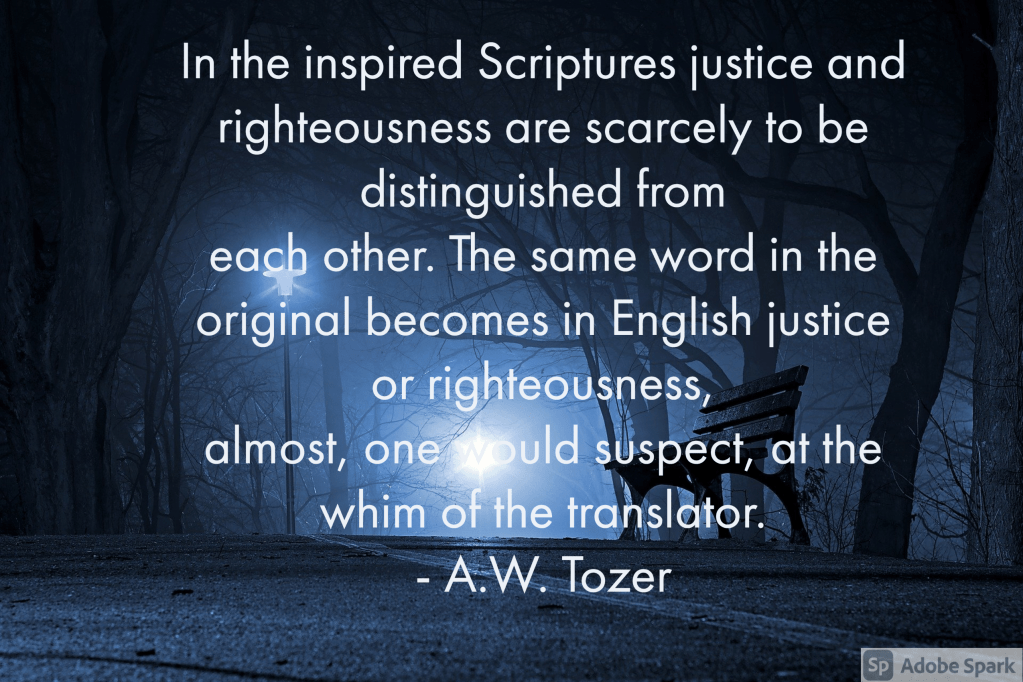
The quote in the image above is from AW Tozer’s book The Knowledge of the Holy. I was told he wrote that while on his knees in humility. Well, I’m writing this laying on my back in submission, so maybe maybe these few thoughts on justice will at least have the humility which comes from having your belly exposed.
There are oodles of books and YouTube videos comparing social justice and biblical justice – Voddie Baucham in particular is a stud when it comes to this question. So I do not want to spend my time allowance on rehashing what you can find in many other places. But it is important, necessary, and plain old polite to offer your own foundation before you tear down another. So what I would like to do is take a few moments and offer some thoughts on what Justice is before I go about saying what it is not.
Let me start with the punchline: Biblical Justice is equally applying the law of God to the image of God. I will unpack this in a bit, but for my purposes going forward this definition will work nicely with the following post on social justice and the church’s response to it. I would like to make a few observations about Justice which hopefully in the end will help bring my definition out of the fog.
deep magic
There are two immutable human characteristics which transcend culture, creed, ethnicity or epoch, and plunge into the deep magic of Genesis: we all bear the image of God, and we all sin. All differences possible in the infinite palette of human individuality are painted on the axiomatic weave of this canvas.
Then God said, “Let us make man in our image, after our likeness.”
Genesis 1:26 (ESV)
The defining characteristic of the human race is the image of God within. From West Coast elite to Australian aboriginal, from Hittite peasant to Silicon Valley millennial, from Nobel laureates to babies with microcephaly, from the octogenarian to the unborn – all are equally endowed with this exact and identical trait measured out with the matchless precision in the machinery of Heaven.
Not only is the image the same in each one of us, but because it is God’s image, it is de facto worthy of dignity. The greater part of justice is the recognition that the same Image is in me that is in you, and in the same amounts.
The second immutable characteristic is that we all sin.
“…for all have sinned and fall short of the glory of God,”
Romans 3:23 (ESV)
Sin is exalting as most valuable what is not most valuable. It is an upending of value, and in doing so corrupts the standard by which we value all other things. When Adam and Eve sinned they placed themselves as the new standard of what is most valuable; the new standard with which all future value will be determined is man. And not just any man, this man: Me. Each of us is the standard of value and what it means to be a sinner is to value most what is not most valuable.
In the above verse, the word “glory” in Greek is dóksa, which has as one of it’s definitions “exercising personal opinion which determines value.” This means that after careful consideration of God’s eternal power and divine nature, it is our personal opinion that Go is lacking in the value department. We all have make this public proclamation in our hearts. This judgement manifests horizontally by tresspassages, harms and hatreds against other, and vertically by declaring He is not valuable, or is less than us anyway. The name we give these actions and thoughts against God and others is called sin.
All sin is injustice in one way or another. When we speak of in injustice in 2021 we typically mean a particular kind of sin where we act in such a way that will benefit us at the expense of others. When we use words like discrimination, inequality, unfairness, favoritism and prejudice, these are specific facets of horizontal injustice.
God, in his mercy, gave us the scales of fairness to deal with this injustice so that the honor due to the image of God might be preserved. He has revealed this to us in various laws and guidelines by which we can make things right when we are antagonistic, careless or dismissive of that image. This law takes into consideration human selfishness by inviting us to think how we would want to be treated, and then treating others in that way.
Admittedly, “law of God” is an ambiguous phrase. What I mean by the law of God is summarized in Jesus’s command to love your neighbor. Practically this can take different forms in different civilizations at different times, like driving a car has different applications if you are in Canada, Wales, or Nepal. But it is important to note that loving your neighbors doesn’t mean allowing, approving or applauding any whim they happen to fancy. Love is the guiding principle for establishing any law. Loving means acting in such a way toward your neighbor which is bounded by God’s being.
Owe no one anything, except to love each other, for the one who loves another has fulfilled the law. For the commandments, “You shall not commit adultery, You shall not murder, You shall not steal, You shall not covet,” and any other commandment, are summed up in this word: “You shall love your neighbor as yourself.” Love does no wrong to a neighbor; therefore love is the fulfilling of the law.
Romans 13:8-10 (ESV)
Loving our neighbors is paying homage to the image they bear; it is how we fulfill this obligation. We do not give preference to the rich or favoritism to the poor (Leviticus 19:15). We do not cheat others (Proverbs 20:23). To protect the accused, we require two or three witnesses (Deuteronomy 19:15). We do not rob them of their dignity by saving people from the consequences of their choices, implying that their actions do not matter, or that they are animals of instinct unable to curb base desire.
Given these two enduring identifiers, the image and sin, God gave humans a moral code, as derived from the unchanging nature of His being, as a ballast when sinful man tilts the scales in their favor. We apply this law equally since we are all equally made in God’s image and we are all alike in sin.
deeper magic
Justice requires a fixed point. It cannot be arbitrary; humans need to be able to build civilizations on it’s precepts. God is this fixed point. He does not change; he is the standard of justice and this standard eternally emanates from His commitment to upholding the worth of His being.
Some have accused God of capriciousness and arbitrariness, saying silly things like deceit is bad only because God happened to want it that way. He could just as easily have decreed lying good and civil society would resemble something like The Housewives of Crete. But this is nonsense. God can no more call lying good than a circle can have corners – it is nonsensical. Lying is bad because God cannot lie. It is axiomatic. What is Just is an extension of the eternal and unchanging being of the self-existing Creator.
But thinking of justice in human terms brings some hairy complications. There is a sense where the above description of justice in terms of the image and the law still feels untethered in some way, as though it is too young to be trusted. I harbor native misgivings of things which are only as young as the known universe – those punks don’t know what they are talking about. If justice is God dealing with sin and sin came after creation, was He always just? Was He just before the creation of the world or did His justice only kick in when sin became a thing? If justice is rooted in the equal treatment of the image of God according to the law of God, how does that apply to God being just before we got here?
There is a deeper magic underneath the rhythms of justice which dives into the councils of eternity. This is key because for something to be immutable, it must be eternal; it cannot be subject to whim, caprice or fiat.
God presented Christ as a sacrifice of atonement, through the shedding of his blood—to be received by faith. He did this to demonstrate his righteousness, because in his forbearance he had left the sins committed beforehand unpunished— he did it to demonstrate his righteousness at the present time, so as to be just and the one who justifies those who have faith in Jesus.
Romans 3:25-26 (ESV)
We see here that God presented Jesus as a sacrifice to demonstrate his righteousness. Why? Because he had left sins committed beforehand unpunished. He sacrificed his son so as to be just. As in, prior to this sacrifice, someone may have legitimately called his justice into question.
Throughout the Old Testament. tragedy was waxing. Like the building tension between two poled magnets forced together, the growing burden of unpunished sin was conflicting with the divine nature of justice. The very name of God was on the line. He had declared himself to be a God of justice and righteousness, but there some apparent discrepancies.
King David was into some shady business. The book of 2 Samuel 11 recounts the seedy details of the voyeur King David creeping on a bathing Bathsheba, sleeping with her (most likely against her will), knocking her up, and then surreptitiously having her husband Uriah killed accidentally on purpose. David covers up his sin, but God sends him a prophet to ferret him out. After the confrontation, David repents and God speaks through the prophet Nathan, “The LORD has taken away your sin. You are not going to die.”
Now imagine you are Uriah’s father. You hear that this king rapes your daughter in law and has your son, who was one of the king’s loyal bodyguards, killed to cover the whole thing up. Then God has the temerity to simply take away the sin? Wouldn’t you start to doubt that God is just? What about the Law that says those who are adulterous must be stoned (Exodus 21:14)? What about the law that God himself wrote that says the murderer shall be put to death (Leviticus 20:10)? So not only did God take away the stain of David’s sin, but he is not even going to apply his own law? One might say Uriah’s father would have legitimate reason to consider God unjust.
Uriah is an example of God’s forbearance leaving sins unpunished. This forbearance was merciful, showing God’s desire for forgiveness of sins, but reveals a serious conflict of interest. Our forgiveness is a threat to His Justice and therefore His glory. God needed to show the world that He is just; he needed to vindicate his name.
The death of Jesus Christ for the sins of man was God displaying his justice in a way that revealed the infinite value of His name, and the value of His image in us. He wasn’t simply knocking skulls in the fertile crescent for six thousand years, instantly punishing sin on the spot. He passed over sins, patiently endured the abuse of his worth, the electrical potential burgeoning between the demand for vindication of His name and the divine forbearance. The forbearance was on purpose so as to show himself just and the justifier of him who has faith.
The deeper magic of justice is God’s infinitely valuing his infinite worth. This eternal act of joy is the music the universe was born into. The definition of justice and righteousness is God valuing what is most valuable and acting accordingly. He has extended this joy to us which we can participate in through Christ.
conclusion
Biblical Justice is equally applying the law of God to the image of God. It fundamentally does the work of showing the dignity of humans. In criminal cases, justice demands that crimes are punished in a way that is consistent with the honor due the image of God within, that is, equally and fairly. When we punish crimes we do so in a manner that fits the crime, with a proclivity to mercy and restoration as much as possible. Since we do not and ought not have laws for every particular of life, we are to threat others as we would want them to treat us.
Mankind is alike in the image and alike under sin; there is no difference. All civic and criminal law is intended to be built on these two foundational qualities of humanity. The dignity of man comes from the infinite value of God’s being, and justice finds its inception in God’s commitment to freely being and upholding the value of his worth. The pinnacle of this was demonstrated in the death and atonement of Jesus Christ offered by God as a sacrifice to God to justify the name of God and justify a people for God.
As I hope I have shown, biblical justice is broad and deep enough to cover all human interactions, ills, wrongdoing, inequalities and mistreatments, as well as how to live civilly with each other in diverse backgrounds given the shared image. This begs the question, what holes are there in biblical justice such that social justice is the remedy? In my next post in this series, this is one of the questions I will be addressing.

 Thought Butter
One thought on “Justice: The Image and the Law”