Introduction To The Introduction
In my sophomore year I was a Zoology major for about 5 minutes. The only class I managed to take was some kind of “intro to zoos” course and in it we had to stuff a mouse – stuff as in taxidermy. There was no observable point to this exercise as far as I could tell other than for some enterprising young zoologist to establish Build-A-Mouse franchises in America’s zoos. They could do children’s parties.
Mouse taxidermying is a highly unscientific process that involves undressing the mouse body from the white fur much like removing a toddler from footie pajamas, except with mice you clip the bones at the mouse-ankles and mouse-wrists. Next, stuff the fur is stuffed with cotton and wire which allows for positioning the limbs in some kind of action pose, or at least a candid one. My first attempt was to position the mouse as though sitting in a wingback chair, legs crossed eruditely, and pensively gesturing with a forepaw. That didn’t work. Gut sutures busted. In the end, I pinned the thing spread eagle to a cardboard square and sent it to my she-friend in Colorado. We married 4 years later.
That story has absolutely nothing to do with anything. I mentioned that little vignette to place me in a zoology class, and in that class we had to memorize a bunch of scientific names for common New Hampshire critters such as the chipmunk, Tamias striatus, and the skunk, Mephitis mephitis. Geez, that was a long walk for a ham sandwich.
Introduction
Modern scientific classification had its origins with Swedish botanist Carl Linnaeus. His intention was to define the patterns of differences and similarities between organisms. In his most famous work, Systema Naturae, he published a formalized structure for naming and classifying all living organisms. Each organism had both a genus and species name assigned in Latin, which bears the ostentatious term “binomial nomenclature.” Similar species were identified as being part of the same genera, genera were collected under the larger canopy of family, families were grouped under the umbrella of order, and so on, up to the largest division between the plant and animal kingdoms. You know this, why am I telling you?
We call this classification taxonomy. For Linnaeus and his contemporaries, living prior to Darwin’s invention of common descent, they wanted to categorize God’s capacious imagination and rationally represent the unchanging Biblical creation in a systematic way.
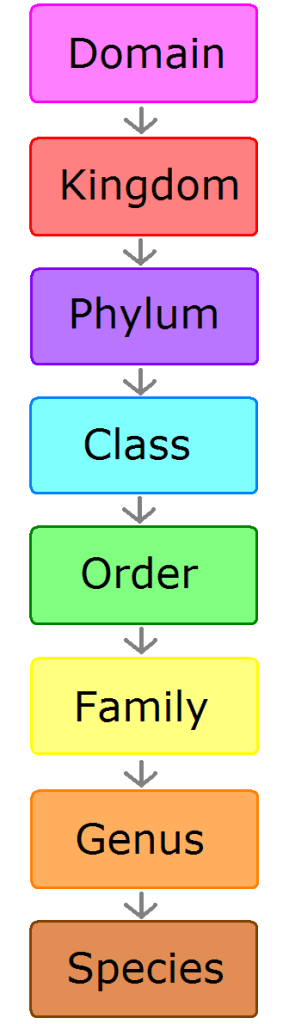
Naturally, as the sciences progressed and new organisms were discovered the taxonomy became more complex, genera became cramped, and higher order taxonomic categories were discovered. New kingdoms were added as our ability to see tiny things improved. In 1990, the super category of domain was added, subordinating kingdoms underneath this larger category. Today, the basic structure looks like the image to the right.
Under this schematic we could place every living organism, with the domains providing the highest degree of differentiation.
This taxonomy, however, is incomplete.
A Higher Taxonomy
There is still a higher division. Call this category Eternality which distinguishes between beings that are eternal and self-existent and those which are not. In this category there are only two branches. The first branch would be things that are created, which includes the entire taxonomic structure as well as created spiritual beings such as angels and demons. In the other branch we find God, with a whole lot of space underneath him.
God is in a category unto himself, that of a self-existing being who relies on no other thing to exist. He is derivative of nothing. At no point did he start to exist. He depends on nothing to continue his existence. He is the only Creative Mind. He is the only eternal being in the cosmos; there cannot be two. He is the only absolutely free being; there cannot be two. Whatever existence is is defined by His existence. The difference between a created and uncreated being is the greatest possible distance between any two things that there can ever be. The archangel Michael has infinitely more in common with a slime mold than with God.
Now, I just broke my own rule and placed God in a category, undermining my entire argument. Forgive me. I will donate my hypocrisy to charity. But it was for the purpose of showing He is altogether outside our category of experience.
Humans are limited in our apprehension of God in that we can only think in the categories provided by our experience. We cannot think in entirely unprecedented terms, and are doomed to consider new information in relation to other referents in our world of experience. To put it another way, if we are asked to create an entirely new creature, it would inevitably have legs or wings or a mouth or some other referent to categories we already have been given. No one is truly creative.
If we are to stretch our minds into the heavens what we would see there could only be described in metaphors, images and words known to the human experience. We are bound by the known to pass the bridge to the unknown. But if we are to apprehend God at all we must necessarily use that which is not God to understand him. As a result, we must deal with the paradox that what we understand Him as will not be Him at all, but only a glimpse afforded to us by the imagination aided by simile and metaphor.
When the seers of the Old Testament returned from their visions their faltering imagination was shot through with more “likes” than a San Fernando Valley cheerleading squad.
As for the likeness of the living creatures, their appearance was like burning coals of fire, like the appearance of torches moving to and fro among the living creatures
Ezekiel 1:13 (ESV)
They were not living creatures, they were like them in some way, and they appeared to have some quality that was like burning coals…or maybe more like torches that flicker? Here Ezekiel must stretch his experience to find some metaphor to describe the indescribable. This is not a problem to be remedied, it is simply the best we can do.
Unwelcome Mystery
But this does not sit well with us. The drive to take dominion which God gave to mankind has mutated into a lust for domination which we have extended into the Heavens. Because we are made in His image we make the mistake that He must be altogether like us, or worse, our invention. Since we have done a solid job of explaining ourselves away into the oblivion of cause and effect relationships, some of our kind have extended the same thinking to God.
So the mystery is erased by explaining away God as a concept of social evolution, a collective brain fart that is only as mysterious than the neurons that invented it. In this sense, the concept of God or gods was a placeholder to help us deal with mystery of our world, a placeholder knowledge had provided a permanent replacement for. At the bottom of it, the mystery of God will be ripped off like a mask to reveal it was Old Man Witherspoon all along, ending this whole religious sitcom like a Scooby-Doo Mystery.
There is also a religious option to rounding off the sharp edges of mystery, and that is to reduce God to manageable terms. Unable to handle the fire and thunder, we make a golden calf that minds it’s own business and stays put. In late stage Evangelicalism this has taken the form of the “Buddy Jesus”, who is a confluence pond of our most sublime ideas, highest values and personal preferences. He can be your roomie if you invite him in to live with you. You can talk about those pesky sins over an IPA, maybe play a round of disc golf afterwards. And, wouldn’t you know it, but most of his thoughts strangely are identical with our own? Buddy Jesus always says just the right thing to rub the soul’s belly. Mystery inevitably is replaced by an image which is well lit and sensible, which is to say not mysterious, which is to say not God.
Why This Matters
But God lies outside all of our categories. He will not be named and filed like some other creature that we fold into our knowledge of the world and slide into the rolodex to be referred to at some later time. He will not appear by reason’s subpoena or submit to the dissection of our curiosities. The Lion of Judah will not become the housecat of humanity.
God is mysterious. We cannot know Him other than what He has revealed to us in nature and His word. But He also must remain mysterious. Of course, we can never plumb the depths of God or smoke Him out of mystery with the light of reason. But we can think we can. We can systematize and categorize and immanentize and display his knowledge in a periodic table. We can then replicate the eternal, package it, slap the nutrition facts on the back and prescribe it, as if God were a spiritual stool softener. The end result is the loss of what is holiest and best either by Him bleeding to death under our knives or by making some wacky Picasso abstraction of His true nature.
The second reason is derivative. Not only is mankind’s mystery a plain fact, it is a necessity. Mankind’s origins must be mysterious. Not temporarily mysterious, like we just haven’t found the right set of monkey bones yet to solve the equation of our origins, but shrouded in unattainable mystery. Mankind must have a higher purpose than roving sexual appetites and a tempestuous will to power. Being made in the image of the mysterious God is the only solution to the yawning meaninglessness of man. The moment we can count all the pieces and draw lines of common descent, the soul shrivels and we begin to jerry rig meaning from the brokenness around us.
Conclusion
God is altogether unlike us, yet we are made in His image, an image we carry around in these skin bags daily. There is no way to avoid this mystery. Explaining God away, we explain ourselves away or convert him into a more useful currency.
Mankind needs transcendence. This will come when we approach God as He is and allow Him to reveal Himself to our hearts through faith. As we dare to ponder the mystery of God, we are drawn up into it, and the mystery of Man throbs with purpose and meaning. Paradoxically, we will find ourselves closer to our true identity, because we were forged in the shape of the Mysterious. When we take the ineffable and try to make it effable, we are effed. That God is an unfathomable mystery should come as a great boon to dessicated souls who are thirsty for the meaning of mystery to slake the eternal drouth.
This proclamation of the mystery of God as it pertains to mankind is the joyful responsibility of the church empowered by the Holy Spirit, and it is a weighty one. Indeed, there is no greater task at present to bless the generations of men.
The heaviest obligation lying on the Christian church today is to purify and elevate her concept of God until it is once more worthy of Him – and of her. In all her prayers and labors this should have first place. We do the greatest service to the next generation of Christians by passing on to them undimmed and undiminished that noble concept of God which we received from our Hebrew and Christian fathers of generations past. This will prove of greater value to them than anything that art or science can devise.
A.W. Tozer, Knowledge of the Holy

 Thought Butter