Introduction
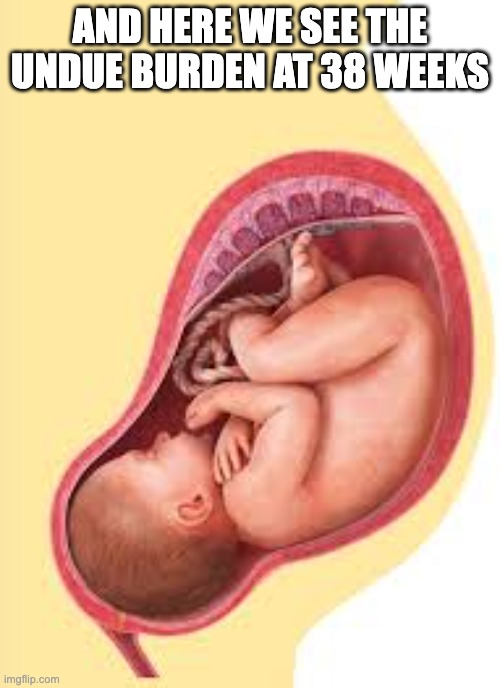
The prime ethic in America is the preeminence of the self. Any objections to our absolute freedom of self-definition are marked for destruction, particularly when these objections have to do with our own bodies. My body. My choice is our first and greatest commandment. Nowhere is this more evident than in the area of “reproductive rights”, which purports to protect the freedom of women to decide what to do with their own bodies.
Of course, this nomenclature is a code word for abortion, which is again code for killing babies, and everybody knows it. Makes you wonder why, if it is the pristine good it is made out to be, we need to be euphemizing it twice over.
At its root, reproductive rights are not about having the right to choose a course of action for one’s own body, but a fevered obedience to the prime ethic of self-definition. This is not some spiritual extrapolation I am making; it is the first link in that jangly chain of precedents cited by the Supreme Court of the United States, which has manufactured these phantasmagoric fetters of abortion on demand.
Chain Links
Through a series of landmark legal cases starting back in the 1960s and continuing through the present day, the rights of an individual to determine personhood have been linked to sexual expression. Here is a sampling of the cases with a brief description of how each nudged the legal system into protecting and justifying what clearly is murder by another name:
Griswold v Connecticut (1965) – The Supreme Court ruled that a ban on contraceptive purchases by married couples was illegal and violated the right to marital privacy. This Right to Privacy, a new discovery by the Court, was a rubric which, though not explicitly named in the Constitution, was present in the “emanations and penumbras” of various Constitutional rights. Essentially, if you took the 1st, 3rd, 5th, 9th, and 14th Amendments and held them up to the light, where their shadows overlapped, the result would be the Right to Privacy. If the couple wants to buy birth control or use condoms, the Court determined it was their right to not have the government muck about in their private business.
Eisenstadt v Baird (1972) – Extended the right of contraception for married couples to individuals, reasoning that a marriage is between two individuals, each having the right to privacy, not only when they are bound in marriage. Each individual must decide on “matters so fundamentally affecting a person like to have a child or not.” Eisenstadt was the first hint we have that a person’s sexual decisions were tied to that individual’s personhood.
Roe v Wade (1973) – Most infamous of legal cases, the Court extended the individual’s right to privacy in contraception to include access to abortion. This established the connection between a woman’s right to abortion and her identity by reasoning that this freedom of choice is essential to maintaining happiness, psychological health, financial well-being, occupational position, etc.
Planned Parenthood v Casey (1992) – Further strengthened the connection between sex and identity. For a woman to explore personhood, she must have the freedom of unrestricted sexual choice while also having the option to avoid motherhood; abortion was necessary for women to define themselves apart from motherhood if they so choose. State laws prohibiting abortion were the State “insisting upon its own vision of the woman’s role.” Banning abortion was equivalent to condemning the destiny of women to the consequences of a sexual act she undertook to define herself.
Lawrence v Texas (2003) – Texas state law banning sodomy was struck down based on the prior precedent that individuals have a right to privacy. The ruling cited Casey, indicating that sexual expression is commensurate with self-definition. Lawrence was a decisive case that eventually led to the legalization of same sex marriage.
This last case does not involve abortion rights, but shows how the same legal reasoning is at the center of both, namely that sexual expression equals identity, and individuals should have the freedom of expressing that identity however they see fit, without any fear of consequences which may deter their identity-forming “sexploratory” acts. And it is plain to see that reasoning is still at work in the legal battle for teenagers to have access to puberty blockers, and whatever nefarious capital letter is next to be added to the LGBTQIA+ firing squad.
Forged through these precedents, a woman’s sexual choices are definitional expressions of personhood, and unhindered access to abortion ensures they can explore identity without the “undue burden” of pregnancy. If the potentiality of pregnancy would even cause a woman to hesitate to engage in a sexual act, having to consider the possible consequences, this would pose a barrier to self-definition. Therefore, outlawing abortion is the same thing as discriminating against the person committing the outlawed act. Deny expression, deny identity, deny personhood.
The Supreme Court put it this way in the 1992 Planned Parenthood decision: woman have “made choices that define their views of themselves and their places in society, in reliance on the availability of abortion in the event that contraception should fail” (505 U.S. 856, 1992). Sexual expression was thus duct-taped to liberty and the whole thing twist-tied to the Constitution via the Fourteenth Amendment, making it all official.
Author Helen Alvare summed up what is codified in the law as “[the Court] firmly linked women’s ability to avoid childbearing following sexual intercourse, with her interest in forming her personal identity.” And therefore, “conduct equals identity, and denying identity denies personhood” (Alvare, 2015). You can read her paper here. It’s really worth it.
We need to be clear about what the “choice” of the Pro-Choice movement is: it is about the unfettered, unhindered, unencumbered freedom for a woman to define herself through sexual acts; even the natural consequences of the choice are considered coercive.
What It Means To Be Human
Fiction authors know that the fundamental reality of story is a character making choices and then experiencing the consequences of those choices. Frodo cannot choose to take the One Ring to Mordor, then tuck into second breakfast as though the act of choosing would somehow unmake the ring. He must walk out his choice and cast the Ring himself into the fires of Mount Doom, suffering the mortal wounds which will come to mark him for the rest of his life. In this sense, it is not the character’s choice we are reading the story for, but the consequences of the choice the character then lives out.
The same is true of life. If I choose to go left versus right, I proceed to move leftward and into whatever consequences, good or bad, leftwardness may bring. I take responsibility for the choice and subsequently gain the victories or suffer the defeats. The highest compliment of personhood God can pay us is to honor the decisions we make, not the least of which is our choice to love him or not. It is precisely the consequences that affirm the reality of the choice and confirm my freedom to make them.
You, reader, as of this moment, are exactly the end result of the consequences of your successive choices. Yes, things happen to us outside of our control or consent, but the soul-shaping response is our own. Autonomy is a huge, meaty chunk of what it means to be human. This freedom to be autonomous is specifically what the Courts were attempting to retain in their decisions, and precisely what ended up being purged. Disconnecting the choice of sexual exploration from the consequence of pregnancy, while purporting to nourish identity, actually decouples the true relationship between choice and personhood.
Conclusion
This bog that has been unearthed by the Supreme Court, cleverly disguised as the noble pursuit of identity, is one long stinky slog through the marshes of putrefying human dignity, each step sinking deeper than the last, towards the confluence pond where this is muck water is draining – the justification of all our lascivious desires. Our gods are our stomachs (Philippians 3:19), as Paul says, and if we are to have the stamina and space to consume all our lusts, we must keep the wombs empty.
Of course, from God’s view, these court decisions are a mockery – is all just pretend. There is no real abandonment of consequences in life. Actions cannot be undone; what is sown will be reaped, what is hidden will be revealed, and in the end, all the pipers will be paid. Choosing to negate the intended consequences of an action is itself a choice that has consequences, which ultimately do define us. Just because some austere and solemn oligarchy knocks a few gavels to justify our sins does not mean we are pulling a fast one on God. He cannot be mocked, and as a case in point, the highest court in all the lands has decreed that it is the apex of moral reasoning to kill the innocent to protect the guilty – a collective burden we all bear.
Abortion is just one more instance of how humans terraform realities to make ourselves after our own image. It comes at the cost of cauterizing our humanity, both by robbing us of the consequences of choice that make us human, but also by the deleterious act of snuffing out innocent life. Far from the light of God’s honest truth, we construct ourselves in the inky penumbras and the smokey emanations spilling from the innocent sacrifices burning on the altar of ego.
Helen M. Alvaré, “Religious Freedom versus Sexual Expression: A Guide,” Journal of Law and Religion 30, no. 3 (2015): 475-495 at 476.

 Thought Butter