Introduction
I recently purchased Out Of Order: Homosexuality in the Ancient Near East by Donald Wold, mostly out of curiosity of the relatively recent flourishing of homosexuality in the present day West. There were questions I was hoping to get answers to, and some I have, but in the midst of the search I came upon another answer to an old question, one so old it forgot it was there, and that is regarding the Curse of Canaan.
The Situation
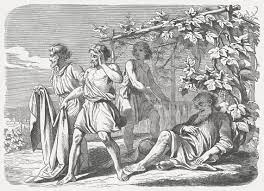
After all the drama of the building an ark, saving humanity, rescuing the fauna, watching the destruction of all living things, Noah needed a little self-care. Plus, when you are six hundred, you deserve a little nip off the vine from time to time. So he plants a vineyard, makes some cheap wine and gets wasted in his tent. While he is passed out, his son Ham comes into his tent, sees him naked and tells his brothers. His brothers are of a nobler stock and take care not to see their father naked. Placing a garment over their shoulders, they walk backwards into Noah’s tent to cover him up. Noah wakes up, understands what happened and drops some curses on Ham. Here is the text:
Noah began to be a man of the soil, and he planted a vineyard. He drank of the wine and became drunk and lay uncovered in his tent. And Ham, the father of Canaan, saw the nakedness of his father and told his two brothers outside. Then Shem and Japheth took a garment, laid it on both their shoulders, and walked backward and covered the nakedness of their father. Their faces were turned backward, and they did not see their father’s nakedness. When Noah awoke from his wine and knew what his youngest son had done to him, he said,
“Cursed be Canaan;
Genesis 9:20-25 (ESV)
a servant of servants shall he be to his brothers.”
Anybody else think this was a bit of an overreaction? Ham was minding his own business, stumbles upon his father’s wrinkled body spread eagle in stupor, snickers at the spectacle, then tells his brothers so they can all get a laugh together. So? Didn’t Noah kinda, sorta cause the problem in the first place? Why so a severe curse? And why did Noah curse Canaan, Ham’s son, and not Ham himself? The nature of the curse is also interesting, in that it makes Ham, through his son Canaan, subservient to both his brothers, and not, I don’t know, go blind or something from seeing Noah in all his withered glory.
A couple things to note here. Genesis, along with the rest of the Pentateuch – the first five books of the Bible – were written by Moses, who lived 15th to 18th century BC, depending on who you ask. The events of Genesis were written down long after they occurred and at a time when the land of Canaan, Israel’s destined Promised Land, was populated by the Canaanites – a group of clans well known for their sexual deviancy. Canaan destiny was already known to Moses, namely that the descendants of Shem, the Israelites, would be more powerful, based on God’s promise. In this context, the curse of Ham landing on Canaan makes more sense in that it explained both the origin of Canaan’s creepiness and the reason for their impending eviction.
But what happened in the tent that brought this curse on Ham? Well, there are two answers that make sense, and one is grosser than the other, and have to do with this curious phrase “seeing his father’s nakedness”.
Option #1 – Eesh and Gross
The phrases “saw the nakedness of” or “uncovered the nakedness of” are used many times by Moses himself as a euphemism for sexual intercourse. Often it describes the unlawful intercourse with the females connected to another man, such as a daughter or wife. In Leviticus 18, Moses uses the phrase eighteen times to describe a number of sexual acts proscribed by the law:
“You shall not uncover the nakedness of your brother’s wife; it is your brother’s nakedness. You shall not uncover the nakedness of a woman and of her daughter, and you shall not take her son’s daughter or her daughter’s daughter to uncover her nakedness; they are relatives; it is depravity. And you shall not take a woman as a rival wife to her sister, uncovering her nakedness while her sister is still alive.
Leviticus 18:16-18 (ESV)
With this in mind, Ham “seeing his father’s nakedness” would be euphemistic for the rape of Noah’s wife, possibly incestuous if she was Ham’s mother. If this is the case, then it could be that Canaan, Ham’s son, was assumed to be the product of this incestuous and unholy union. This makes an otherwise incongruous connection more clear, since Canaan would have been defined by sexual deviancy leading to Canaanite local atrocities such as Sodom and Gomorrah, which boasted a most insalubrious welcoming committee.
Later, when addressing the Israelites, Moses warns that sexual immorality will cause the land to “vomit them out”, a destiny which certainly applied to what happened to the Canaanites through the Israelite conquest of the land, and then to the Israelites themselves via the imperial conquests of Assyria, Babylon and Persia when they gave way to sexual perversion.
Culturally, assuming control of the father’s harem was common practice in the ancient near east and symbolic of showing dominance over the predecessor, as we see when David’s son, Absalom, goes into his father’s concubines when he declared himself the new king in David’s place (2 Samuel 16). Perhaps Ham’s actions was an attempt to show his dominance over his father and brothers by taking his father’s wife, setting himself up to be the hot new patriarch of a freshly washed world. And because of this attempted dominance, the curse was to make his progeny perpetually subservient in direct contrast to his usurpation of authority to make his brothers subservient to him.
Option #2 Yuck and Ew
Another theory, which also uses the euphemism “saw his father’s nakedness” but in a totally different, and disturbing, way, is that, while Noah was passed out, Ham raped him. Yuck, ew and, if I may add, wowsie.
How do we arrive at such a disturbing theory? Firstly, the text places Ham inside Noah’s tent (“…and told his two brothers outside”, indicating he was inside the tent). Secondly, the Hebrew verb gala, is used only of males, since they are the aggressors, the penetrators, then the verb usage here may be referring to Ham. Lastly, in the laws mentioned above you will notice that the unlawful sexual action, euphemistically referred to “uncovering”, is done to a female, “You shall not uncover the nakedness of your father’s wife,” – the one who is penetrated is identified as female. But there is no female mentioned in Ham’s action against his father, it was Noah himself who was the recipient.
Extra biblically, there are clues from documents in the ancient near east that there also was a dominance established through homosexual penetration. There are very few documents from Mesopotamian cultures which proscribe homosexual activity legally. The ones we do have are ritualistic or magical in nature and read more like a social rules or cures for trouble. Here are a couple examples from the Mesopotamian summa alu texts, which antedate Levitical law by a thousand years or so:
If a man has intercourse with the hindquarters of his equal, that man will be foremost among his peers and colleagues
If a man has intercourse with a (male) cult prostitute, care [in the sense of trouble] will leave him.
Anal intercourse in the ancient near east, at least in part, was viewed as a sign of dominance, much like the supplanting of a ruler through taking the harem. So maybe Ham, seeing his opportunity granted by Noah’s drunkenness, dominated his father and then went out to show his brothers what he had done, so there was no question about who was boss of this new world? If so, Ham’s action would be the the archetype of sexual sin, one that included rape, homosexuality and incest, all later practiced by the Canaanites, the son of Ham.
Given these two possibilities, one more heinous than the other, the curse of Canaan takes on more weight, context and believability than if he was merely snickering like teenager who saw his father’s old balls.
Conclusion
Does this gross bit of history change the way any of us live? Probably not, but it is an interesting point of fact and deepens our understanding of these real people that lived a long time ago. Also, stepping back and taking a wider scope of homosexuality and its history in the human race will be important in the decades to come. Already many Biblical scholars are explaining away homosexual acts in the Old Testament, making the presumed deviance of the circumstance about the attached incest or forcible nature of the act instead of the act itself. Ultimately, homosexuality is about the destruction of order and intention God made for humanity, and how that order historically has been corrupted for heinous purposes, be they lustful, powerful or cultic.

 Thought Butter