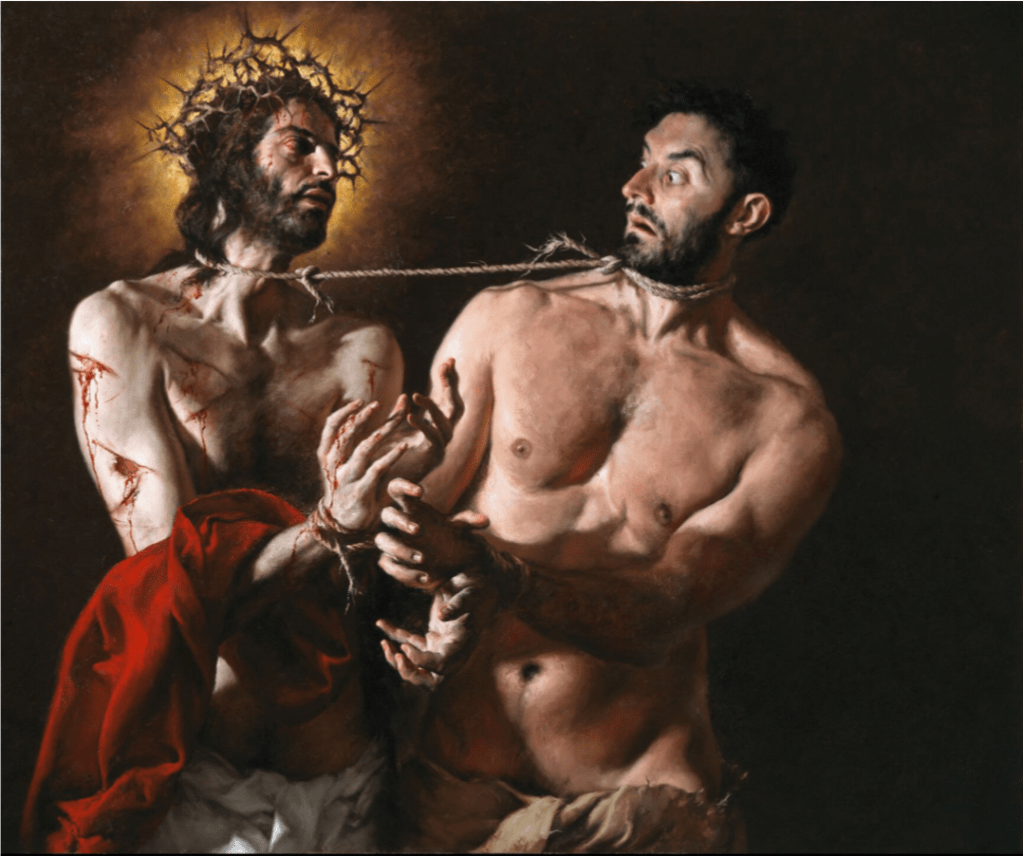
Though Israel had many periods of judgement and restoration in their history with God, the gavel of God’s final judgement fell against Jerusalem at one particular moment captured in the Gospels. While their Messiah stood bleeding and beaten before them, the religious rulers of Israel riled up the crowd to call for the crucifixion of Jesus, in a final rejection of their true King in exchange for another. Though this sentence would not be carried out for another forty years, the ruling was decreed, and the doom clock of their destruction began.
Jesus tells a parable of vineyard tenants who rented a vineyard from a man, allegorizing the tumultuous relationship between Jerusalem and God and portented the grizzly conclusion:
And he began to tell the people this parable: “A man planted a vineyard and let it out to tenants and went into another country for a long while. When the time came, he sent a servant to the tenants, so that they would give him some of the fruit of the vineyard. But the tenants beat him and sent him away empty-handed. And he sent another servant. But they also beat and treated him shamefully, and sent him away empty-handed. And he sent yet a third. This one also they wounded and cast out. Then the owner of the vineyard said, ‘What shall I do? I will send my beloved son; perhaps they will respect him.’ But when the tenants saw him, they said to themselves, ‘This is the heir. Let us kill him, so that the inheritance may be ours.’ And they threw him out of the vineyard and killed him. What then will the owner of the vineyard do to them? 16He will come and destroy those tenants and give the vineyard to others.” When they heard this, they said, “Surely not!” But he looked directly at them and said, “What then is this that is written
Luke 20:9-16 (ESV)
Envoys were sent to the tenants to remind them of their obligations to the owner, who were beaten and tossed out out of the vineyard for their trouble. Finally, the owner sends his own son, reasoning that certainly the heir to the vineyard will have some clout with the renters. Instead, they conspire to kill the son so the vineyard will be theirs. From the parallel story in Matthew, it is clear that the the listeners knew Jesus was talking about them, and because of his hubris they decided to kill him, playing their part perfectly.
While Jesus is on trial before Pilate, Jerusalem is on trial before God. Fearing both the Jews, and shaken up by his wife’s ominous dream, Pilate has Jesus flogged and humiliated, hoping this would appease the ravenous crowd. It does not. They want the death penalty and they meant to get it, even going so far as to throw out a not-so-veiled threat, saying that if Pilate lets Jesus go he is “no friend of Caesar, and everyone who makes him king opposes Caesar.” Well, Pilate knows perfectly well the fresh hell that not being Caesar’s friend brings.
As it was the feast of the passover, the Roman authorities at some point in the past had started a ritual of allowing the release of one prisoner, possibly to show a measure of goodwill, though more likely to placate the Jews from uprising, as they were wont to do from time to time. Pilate offers them the release of Jesus, seeing their seething envy through the hollow and pretentious accusations of the chief priests. They refuse the offer, opting for the release of Barabbas.
As we know from the text, Barabbas was “a man who had been thrown into prison for an insurrection started in the city and for murder” (Luke 23:19). What this insurrection was exactly we do not know, other than it was against the Roman authority, a crime punishable by crucifixion. So he was an insurrectionist, and not like the January 6th kind, but one of those murdery ones who was not afraid to get his hands bloody for the cause.
Origen, the early church father, as well as several original gospel manuscripts have Barabbas’ full name as Jesus Barabbas. Jesus was a fairly common name at the time, as it is the equivalent of Joshua, and I personally knew a handful of Joshua’s even in my day (one in particular a rapscallion, but had my back in a pinch). Joshua means “the Lord saves”. Perhaps the first name was removed by a copyist of the manuscripts so as to not confuse or denigrate the name of Jesus. More interesting still, is that “Barrabas”, a surname, means literally “son of the father.” Some scholars believe Barabbas was the son of one of the Sanhedrin, the ruling class of Jews in cahoots with Rome, and also the kabal desperately trying to get rid of this Jesus character wrecking their life and religion. In other places, Jesus calls these people the son of the devil (John 8:44).
Furthering the contrast is that Barabbas was a participant in an insurrection against the Romans, trying to bring Jewish freedom from earthly oppressors. Jesus forbiade Peter from doing the same, saying his kingdom was not of this world. J
To make this juxtaposition more juxtaposey, we have two men whose name means the Lord saves, the one saving from sin and wrath, the other from Rome; both bear titles son of the father, one the son of the God of the Universe, the other the son of a devil; both on trial for fighting oppressors, one through resurrection, the other through insurrection; both facing crucifixion, one innocent, the other with blood on his hands.
Shortly after Barabbas is cut loose, Pilate has Jesus flogged and presented to the Jews who were in the crowd declaring, “Here is your King.” The Jews respond “Away with him, away with him” (John 19:15). A more literal translation would be “Raise him up, raise him up,” the allusions to raising up on a cross are apparent. Pilate, incredulous at the irrationality of the crowd responds, “you want me to crucify your king?” For truly, Jesus was their king, though Pilate did not know what he was saying.
“We have no king but Caesar!” Sooner than proclaim Jesus as their king, they proclaim a heathen emperor as king. They abandoned the Messianic hope for which they for millenia had been waiting and the priestly organs of this theocracy by which the nation was led had abandoned faith and rejected God.
Hear the gavel’s fall. This was the final choice of the long and storied tragedy of Israel. For centuries God had preserved and loved Israel, his chosen people, and for all his trouble they rejected him and chose as their king the emperor cultus, Caesar. This king would at least let them keep their religion that had become so predictable even if it was empty. God was rejected as their Lord and king in exchange for continuing the status quo, even if it was under the demoniacal worship of the emperor of Rome. And here is where the parable told by Jesus comes to fruition, they killed the son of the vineyard owner so they may keep the vineyard.
Because of this choice, the judgment of God fell on Jerusalem. Even as Jesus is being led away to the Place of the Skull, he warns those who are weeping for him:
Daughters of Jerusalem, do not weep for me, but weep for yourselves and for your children. For behold, the days are coming when they will say, ‘Blessed are the barren and the wombs that never bore and the breasts that never nursed!’ Then they will begin to say to the mountains, ‘Fall on us,’ and to the hills, ‘Cover us.’ For if they do these things when the wood is green, what will happen when it is dry?”
Luke 23:28-31 (ESV)
As he prophesied, within a generation of his death and resurrection a hell would descend on the tenants of the vineyard the likes of which the world had never seen. This horrific account is chronicled in “The Jewish Wars” of Josephus, painted in apocalyptic poetry in the Revelation of John, and testified to by Jesus himself in the Olivet discourse (Mark 13, Matthew 24 and 25, and Luke 13), and reached its bloody climax in the destruction of the Temple in 70 AD.
But it is not as though the word of God had failed, for not all who are Israel are of Israel. To those who receive Him, to those who believe in his name he gave the right to become children of God. Many Jews escaped the tribulation of the Jewish Wars by heeding the words of Jesus, their King. These took the message of the gospel into the world and started the long, joyful, painful, process of bringing the kingdom of God to the world, declaring the reign of a new King, Jesus Christ, Son of God – a glorious and ongoing labor.

 Thought Butter