Enter by the narrow gate. For the gate is wide and the way is easy that leads to destruction, and those who enter by it are many. For the gate is narrow and the way is hard that leads to life, and those who find it are few.
Matthew 7:13-14 (ESV)
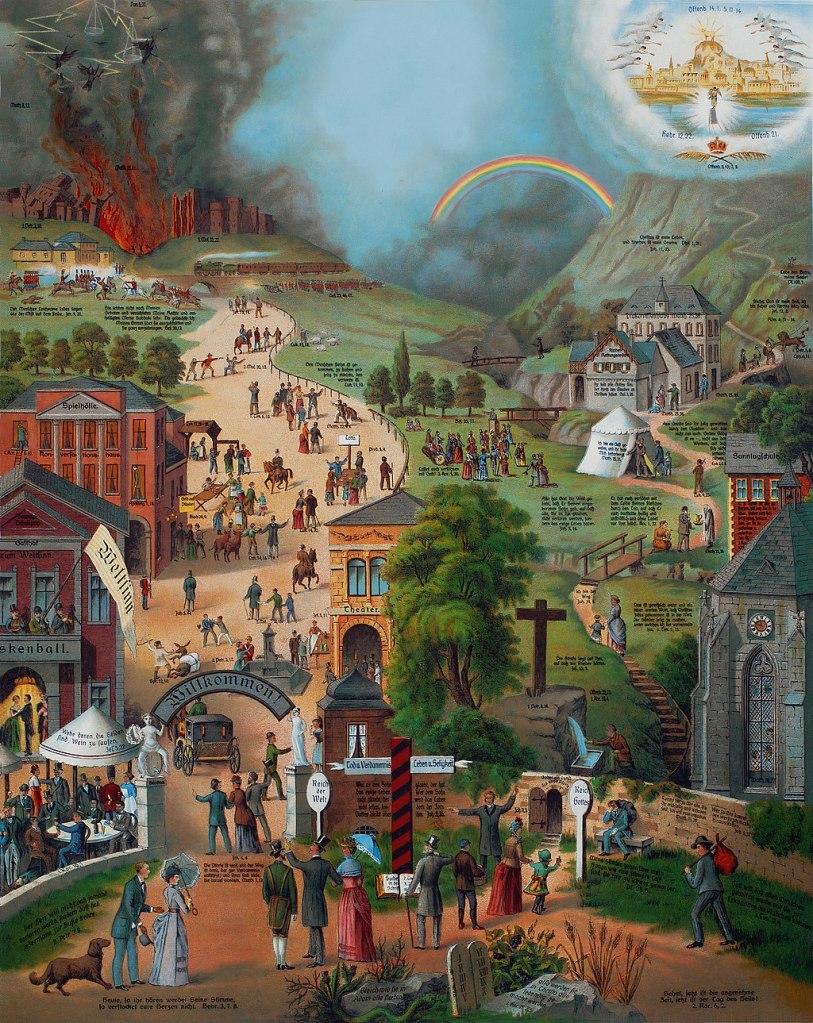
This is one of the more commonly used word pictures Jesus gave to us in our evangelistic endeavors. The meaning of the parable lies on the ground, unwrapped: the truth is a jagged pill to swallow and unpopular with the masses. Down the narrow road lies austerity, discipline, and refusal of the natural appetites, but ultimately salvation. It is the kind of thing Buddha could get on board with. Poverty, chastity, fasting, sobriety – the straight straits of self denial.
In contrast, the way that leads to destruction is a cinch. No rotten fruit from the jeering crowd, no peer pressure to conform, always plenty of leg room and free peanuts. We can skip arm and arm with Lampwick across the drawbridge to Pleasure Island. The way is broad enough to accommodate our swollen pride and fat hearts, and wide enough for us to pass through with our saddlebags stuffed with fardels of riches.
This verse is a staple of evangelicalism, calling out to a world where the inertia of our sins and the entropy of our spiritual demise are leading us to the lowest possible energy state, wide enough to stroll unopposed through life, but destined for destruction.
The parable is very true and certainly applicable to a variety of situations in life, but there is a word in there that doesn’t seem to fit. What did Jesus intend for this parable, and why did he say there are only a few who enter life? What is he talking about here?
A Few Good Men
Presumably, this means that in heaven there will only be a few people. This certainly seems to be the common understanding of the passage. I mean, how else are we to take this? Over the infinite tracts of heavenly acreage, there will be a few hundred thousand Christians joyfully grazing on the celestial grass, those precious few who have found the narrow way over the centuries. Hell, on the other hand, will be stuffed; the Lake of Fire will exceed its occupant capacity.
Put another way, if every soul that has ever existed was a grain of sand placed on a balance scale, with the damned on one side and the saints on the other, the weight of the damned would have busted through the table and buried itself three feet into the earth, while a few saintly grains loll about on the other plate as it swings freely, unencumbered with mass.
And who are these lucky souls that stumble upon the narrow way? Is there something special about them? Do they have a higher pain tolerance? Were they born more patient that others? Did they have the gift of celibacy? All of those character traits that fit someone to enter through the narrow gate can be willed into place with sheer force. The instructor of my wife’s BodyPump class would be great for this gate. Extremely hard and only the few make it? That’s her jam. She loves a good challenge, and maintains her percent body fat just out of reach of menstruation.
And so we exist with this unbothered assumption in our minds that Heaven will be sparsely populated with the few, and Hell teeming with masses.
Few Means Many
But there are several problems with this view. Namely, in the very next chapter, Jesus says that many will come from east and west to the table of Abraham, referring to the sea of Gentiles who will come to salvation.
When Jesus heard this, he marveled and said to those who followed him, “Truly, I tell you, with no one in Israel have I found such faith. I tell you, many will come from east and west and recline at table with Abraham, Isaac, and Jacob in the kingdom of heaven, while the sons of the kingdom will be thrown into the outer darkness. In that place there will be weeping and gnashing of teeth.
Matthew 8:10-12, ESV
“Many” in Greek is polloi, meaning lots, a grip, heaps, tons, oodles, mucho, in other words, not a few. So which is it, many or few?
And speaking of Abraham, God promises his descendants would be as numerous as the stars, and I don’t think we need to camp on the fact here that there are not a few stars in the sky, Abraham’s gaze unhindered by light pollution and all. Who are his descendants? The Christians are his offspring, who currently make up the largest religion on the planet, estimates surpassing 2 billion, not counting the millions of the faithfully departed. In other words, not a few.
But, you may say, just because there are that many nominal Christians doesn’t mean they are serious, true believers; they might not mean it. Granted. Some people do just wear the name tag, worshipping God with their lips, yet having wayward hearts. But if we are to maintain our definition of “few” this means that the vast majority of presumed Christians through time were and are apostates, pruned branches destined for the fire. Based on what criteria do we judge this, and would we be willing to apply the same standards of loyalty to ourselves?
To assuage the discrepancy, we site the Biblical motif of the Remnant. Noah and his family were a remnant of humanity. A remnant of Israel was saved from the Assyrian invaders. A remnant returned to Jerusalem to rebuild the walls. In Revelation, a remnant of Christians will be preserved. True, but what is the nature of remnant?
The remnant doesn’t stay remnanty; it expands. From the eight people who escaped the Flood we are currently brushing on 9 billion. Of the small band left in Israel, a population of over fifteen million is currently at large on earth. The remnant of Christians from Revelation expanded exponentially to near two billion. These aren’t carpet remnants; these are not small swatches of humanity that stay small. Remnants are a chosen group of people selected to grow.
But even if we remain unconvinced, we still run smack into Jesus’s stated mission, the reason why he was sent. John 3:16, where we magically shrink “the world” to mean the few whosoevers who believe in Him, is buttressed by the next verse where Jesus makes the scale his mission clear.
For God did not send his Son into the world to condemn the world, but in order that the world might be saved through him.
John 3:17 (ESV)
If we maintain that there will only be a few souls over the centuries that choose the narrow gate, then we either need to seriously reconsider that “savior” doesn’t mean what we think it means, or Jesus’s conception of the world is an adorable yet insignificant portion of the world as we know it. He is talking about saving souls here, not the planet. He didn’t come to rescue the Russian steppe from bondage or stop deforestation of old growth forests. He came to save the bearers of the image of God from eternal separation and to reconcile them to their Maker, and the number of souls that will be saved so vastly outnumbers the damned that he can just go ahead and round up and say the world.
So our options here is that when Jesus said “few” he really meant a number exceeding a couple billion, including the “many” pouring in from the gentile world he refers to five minutes later, and that Jesus’s “world” saving endeavor really means only a tiny remnant of the world, leaving us questioning why didn’t God just say that to begin with like he did in other places, instead of all this “world” talk.
But what has much more explanatory power, and is more in line with Jesus’s stated mission, is that the few who enter the narrow gate is not referring to all of humanity but the Jews living in the first century.
Few Means Few
The passage is at the tail end of the Sermon on the Mount. The context, presumably, is Jesus is talking to a hillside peopled with Jews overlooking the placid Sea of Galilee. Some think this little portion may have been tacked onto the Sermon, as there is no adjoiner, but we will take the obvious stage directions provided and assume it was part of the monologue.
That Jesus references himself a couple of times in disguise in this passage is obvious. In John 10:9, Jesus calls himself “the gate”. And we know that Jesus is “the way” because he told us he was in John 14:6. So the narrow way and the gate are both Jesus. Of course, Jesus is just as much the gate and the way for us today as he was for the Jews back then.
But what Jesus is foreshadowing here is how difficult it will be for the Jews to accept him, a fact that is plain as we read the gospels, and further supported by first the persecutions of Christians mounted by the first century Jews. Jesus was rejected by his own. He was an outcast among his own people. His family thought he was nuts and staged an intervention (Mark 3:21). Many knew him to be a bastard (John 8:19). He was abandoned by all but one of his friends (Mark 14:50). He was not accepted in his home town (Mark 13:57). He was accused of being a son of Satan (Matthew 12:24). He was rejected by men (Isaiah 53:3). On eight separate occasions at least, before his crucifixion, crowds tried to kill him. Many thought he meant to upend their culture and heritage (Matthew 26:61). After his death, his followers we reduced to a mere 120 Jews, and by the end of the the Jewish era and the destruction of the temple in 70Ad, though the gospel had spread miraculously among the gentiles, it is estimated less than 10% of Jews were followers of Christ. In other words, a few.
So the “few” Jesus is referring in the narrow gate analogy is the Jews who are listening to him, the ones sitting on their tuchus in the grass in front of him, most of whom would reject him. His teaching was hard for them because he was a man claiming to be God, a blasphemer, bound for Sheol, a son of perdition, and the same for all those who would follow after him.
Conclusion
Sad as it is that only a few of the Jews followed Christ, there is some good news here. First, it means that when Jesus says “few” he means few, not some strange mental gymnastic, greek-word-taffy stretching understanding the word. Secondly, it removes a roadblock that has sat incumbent in our minds about our expectations of Jesus’s mission being fulfilled. It is not only a few souls that will be in heaven, but many multitudes, just about the same number as stars in the sky. We needn’t be wary that God is stingy with his grace or expect that only a holy handful will make it through the gate, bedraggled and weary, where they are finally let out to a sparely populated pasture. Heaven will be chock full, and Hell full enough, but not nearly as much, if Jesus is going to save the world like he said he was. And the Word is a man of His word.

 Thought Butter