Our lightning access to the collective knowledge of the world through the Internet comes with a sewage pipe emptying into our living rooms.
Most attentive parents are careful what kinds of images flicker in their kids’ faces, and have dammed the gaping goop hole with blockers and restrictions, though it is impossible to plug up entirely. I would site some crippling stats here about the accessibility and ubiquity of internet porn, but no one needs stats anymore to know the extent of the problem. You’ve heard it before and chances are, if you have kids, you have had first hand experiences with this stream of egesta slopping into their faces, and have put the appropriate safeguards in place. Love is patient, love is kind, and, nowadays, love is nosey.
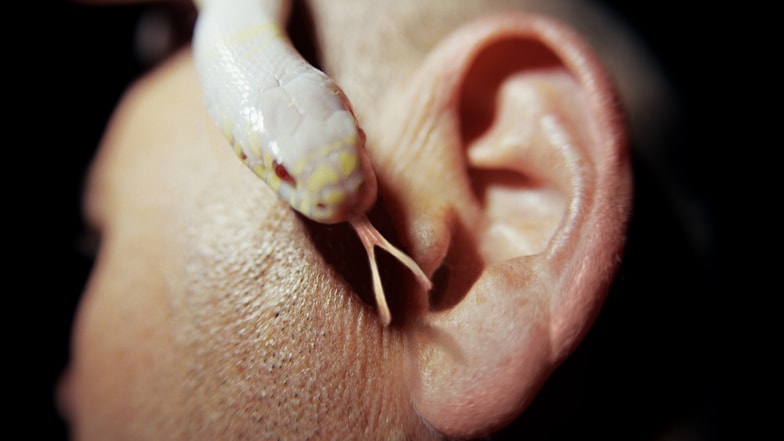
However cautious we are about the porn that slinks in through the eyes, we are considerably less wary of the kind that drips into the ear. By ear porn I don’t mean the sleazy romance novels on Audible read by some undersexed librarian – that kind of audio erotica is easy enough to avoid. I am talking about the spores from all the mushroom rot that grows on the Spotify playlists. You know, the murderous rage to put to music, the licentious lyrics set to 4/4 time, and the forlorn solipsism of the suicidal, all highly produced and manufactured to make the ear drum jiggle just so.
If the lyrics of a song were as evident at the nutrition facts on a box of Raisin Bran we would be more selective to what we hear. Unfortunately, that black and white postage stamp of “Parental Advisory: Explicit lyrics” in the bottom corner doesn’t distinguish between your kid’s favorite song that has an innocuous four letter word buried in the bridge, and The Lullaby of Jeffery Dahmer sung by Voldemort. Most of us, present company included, not only give less attention to what is going into our kids’ ears but our, own as well.
But we ought to. There is something peculiar about what we hear that affects us in a different and more profound way that what we see. What are these dangers and why are they dangerous?
Imagination
The Fellowship of the Ring, the first book of the Tolkien epic, is still the case study for fantasy authors on world building. The scope is massive, the characters deep and the descriptions of beauty traverse the literary to land in the nose or brush against the skin. During their journey, the Fellowship must tunnel under the Misty Mountains, through the Mines of Moria, and in these recesses they encounter the Balrog, a demon of the ancient world. Here is Tolkien’s description:
The Balrog reached the bridge. Gandalf stood in the middle of the span, leaning on the staff in his left hand, but in his other hand Glamdring gleamed, cold and white. His enemy halted again, facing him, and the shadow about it reached out like two vast wings. It raised the whip, and the thongs whined and cracked. Fire came from its nostrils. But Gandalf stood firm.
‘You cannot pass,’ he said. The Orcs stood still, and a dead silence fell. ‘I am a servant of the Secret Fire, wielder of the flame of Anor. You cannot pass. The dark fire will not avail you, flame of Udûdun. Go back to the Shadow! You cannot pass.”
JRR Tolkien, The Fellowship of the Ring
Now let me ask you, did you imagine anything other than what you saw in the film? A soot faced Ian McKellan with a bulbous nose facing off against the massive, hook-horned fiend? And if you had read the book prior to seeing the film, can you now remember the scene your own imagination painted, or has it been evicted by Jackson’s strong visuals? Me, I cannot remember how I imagined it once.
Accepting the visual creation of another is neither good nor bad, per se. The sharing of imagination is part of what it means to be human and a co-creator in God’s image. But it does mean we are unable to then unsee another’s interpretation and go back to a clean slate, as it were, if you read a passage of fiction for yourself. We adopt their imagination and enjoy it, or perhaps build on top of it, but it comes to us pre-assembled and required nothing of us to bring it about, only to climb inside of it. We are not co-creators of the scene, but passengers.
Hearing is a different process altogether (and I would include reading as a subset of hearing in this case). Tolkien’s passage about the Balrog requires a body, a scene, action, emotion and context. The writer provides the ingredients and in our minds we pull from our own experiences, dreams, fears, fantasies – our imagination – to bring it to life in our minds. We are partnering with the artist as co creators in the process of imagination. If one hundred people drew their interpretation of the same scene we would see some similarities, but notable differences as well.
This is often why the book is better than the movie, because we are able to dig into the dungeon of our own fears and haul up those nameless horrors and their attendant phobias, or have those words the Sage speaks to the hero heal a deep, red wound in us which we brought into the adventure. We make it our own and so what we hear grows into us in a more profound and meaningful way than observing the end result of someone else’s fears, dreams, and failures put to visual media.
Emotional Traverse of Space and Time
Pachelbel’s Canon is one of the most recognizable classical pieces today. Many a bride has floated down the church aisle to its soft, predictable complexity. And it was written in “D”, which I always thought was a good choice. As a sophomore in college I bought a CD that had something like 15 different variations of the piece, some in the Baroque style, some in brass, a couple strings – surprisingly, no didgeridoo.
But one variation haunted. The foundation of the piece was the traditional Pachelbelian procession, but as I listened to it over and over, it seemed as though there was a dialogue going on between a cello and violin in the foreground, which I had always imagined as an intimate conversation between a father and his son. In the beginning of the piece, I imagined the the cello speaking warmly, reassuring the timid violin, which echoed in higher octaves, as though comforted. This dialogue broke open in the middle of the piece, spilling chaotic and undulating fear, and the two instruments were separated and swirled in the maelstrom. By the end, the positions had switched, the violin now speaking reassurance and the cello reluctantly working to some sort of resolution. Quietly, the piece tapered off with notes that stretched over measures – a last breath – until it was unclear if the piece was over or so fragile as to be inaudible.
Years later, I learned that the composer had a son who died in his youth. He had composed this variation in remembrance of him.
How was it possible for this man to put his heart and experience into string vibrations and send them across space and time, wordless, and I was able to interpret, not the specifics of the son’s death, but the very heart of it? The intimacy and emotional resolution of the piece came to define a huge part of my college life and would listen to it on repeat as I sat in the still twilight of my greying dorm room.
Music matches lyrics. You will not hear a death metal band sing about their love of donuts. The combination of lyrics and music massages the emotion of the song into the soul in a way just reading the lyrics would never do. Emotions are packaged in music; lyrics are not mandatory.
But hey, maybe your kid “just likes the music and doesn’t even listen to the words.” That is exactly my point. If Lil’ Baal rapping about fornicating with corpses tops your kid’s Spotify list, the emotional transference through the music still penetrates even if the lyrics are undiscernible.
Faith Organ
Perhaps more important is the relationship of the eyes and ears to faith. Anyone who has talked to an insufferable atheist knows how icky the idea of belief without sight can be. Paul makes it clear
So faith comes from hearing, and hearing through the word of Christ.
Romans 10:17 (ESV)
Jesus attaches a special blessing to belief that comes through hearing
Jesus said to him, “Have you believed because you have seen me? Blessed are those who have not seen and yet have believed.”
John 20:29 (ESV)
Ears are the organ of faith, of belief, of trust. We take in the testimony of another and become confident in its reality. There is opportunities through the ears that are not extended to the eyes, and even in opposition to them. Those who demand a sign exclude themselves from the certainties that faith brings, and in God’s economy, all the attendant blessings he has for us are only accessible by this medium. Faith levels the playing field, and intelligence, wealth, class, race and any other physical distinction melts away and all have equal access by faith, which comes through hearing.
Belief, once nested in the heart, comes to change everything about us. All actions and words are beliefs embodied. The music we listen to also comes by means of hearing and as such retains the raw material that beliefs are made from. A bullied kid may not know how to respond to their pain and experience, but Rob Zombie’s Let the Bodies Hit the Floor may have an explanation and solution about his reality which takes root in the heart.
Conclusion
Good parents are nosey. Not only what our kids have been looking at but also the kind of liquid being poured into their ears, which has a mainline to the heart in a way no other sense we possess that connects us to the outside world. Practically, this means listening with your kid to the selections on the playlist, practicing tuning in to what emotions the music is trying to transfer, and scouring the lyrics for meaning and intention.

 Thought Butter
Such dark times we live in, truly. I am starting to believe that it is less about “holding off” the darkness as it is growing the light inside ourselves. I think that our children, sadly, must learn to face the darkness and consistently choose the light. That is the only way they will survive this generation- it may come with much stumbling, but God is faithful and will lead us to victory. “The light shines in the darkness, and the darkness can never extinguish it.”
John 1:5 NLT
But yes, hearing is very powerful. We learn to guard ourselves accordingly. And yet, as wickedness increases, surrounds us and confronts us- our only hope is that Jesus is transforming us into new creations that when all else fails, can stand against the darkness (like Gandalf).
LikeLike