The following are thoughts on trial in the Christian life and reads like of a stream of consciousness, with some paragraphs knuckled together, others free floating. Having recently been the recipient of a bespoke divine trial, I wanted to recount some of the thoughts inscribed on the cold stone walls in the bottom of the well, some from me, some from others lowered into the same.
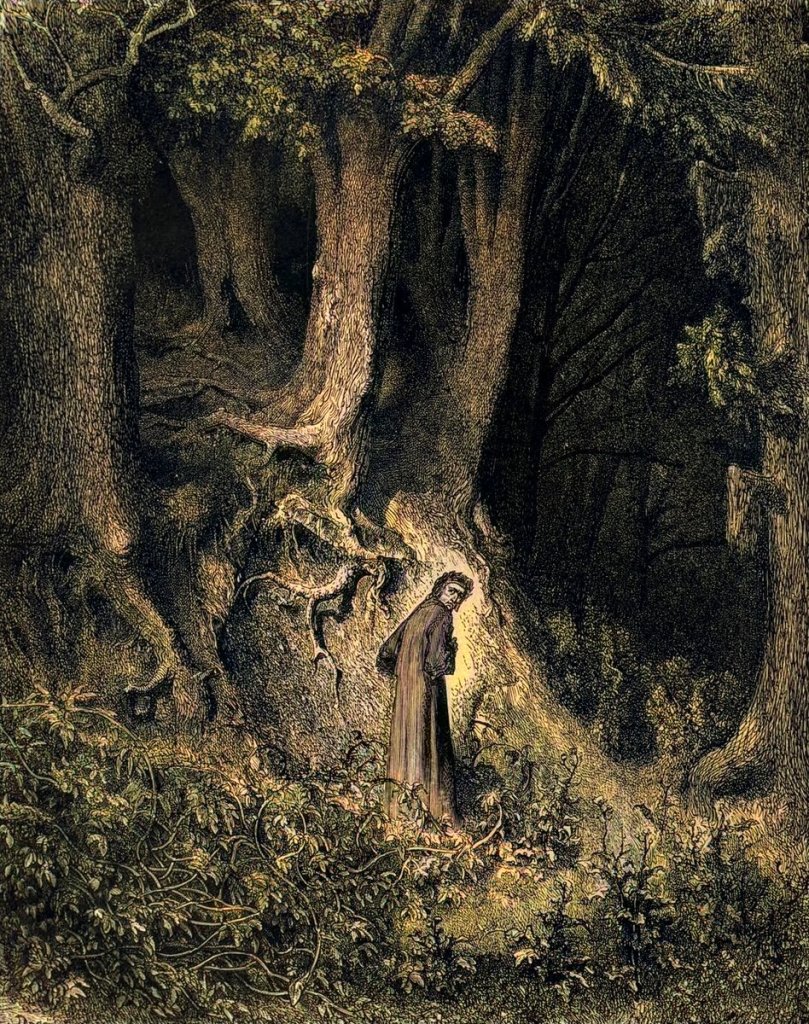
Midway upon the journey of our life
Dante Alighieri, Inferno, Canto I
I found myself within a forest dark,
For the straightforward pathway had been lost.
Gustave Dore illustrated many classic works with his dark and haunting etchings such as Paradise Lost, the Bible, and the Rime of the Ancient Mainer. The one to the right is his interpretation from the first line of Dante’s Inferno, quoted above. There is no image I have seen that captures the trepidation, loneliness and surreality of lostness better than Dore’s etching of a hunched Dante, alone and amnesiac, at the maw of a deep wood, a threshold sunlight itself refuses to cross.
He doesn’t know how he arrived at the mouth of this forest savage, other than in a moment of carnal slumber he had “abandoned the true way”. Looking upwards, he can see the light of the sun crowning the hilltop and attempts to climb himself out of the valley, only to find his way blocked by a leopard, a lion and a she-wolf. He is turned back. This scene begins Dante’s journey, guided by the poet Virgil, down through the concentric and exponentially gloomy circles of Hell before he begins his climb to the heavenly spheres in Paradiso. Dante’s darkness was a purgative grace from God, one to which the heights of glory were preceded by equally cavernous woes.
Francis Thompson was a skittish, mystical 19th century poet. After living a debauched life, nursing an addiction to opium and ending up on the filthy streets of London, he was housed and fed by an anonymous prostitute. A catholic couple, who became his editors, pulled Thompson out of the mire of his broken life and he wrote the Hound of Heaven as an autobiographical saga of his determination to find love anywhere but God, and God’s relentless pursuit of him by thwarting his attempts. The Hound of heaven chased him with “unperturbed pace” until Thompson, exhausted and hewn to pieces, is caught and the purpose of the Hound revealed. In his concluding stanza he cries:
Halts by me that footfall:
Francis Thompson, Hound Of Heaven
Is my gloom, after all,
Shade of His hand, outstretched caressingly?
‘Ah, fondest, blindest, weakest,
I am He Whom thou seekest!
Thou dravest love from thee, who dravest Me.’
In the end, Thompson’s revelation is that his pursuit of loves was really a fear that caused him to flee from Love Himself, a revelation he shares with us in the oft repeated line “Fear wist not to evade as Love wist to pursue.” Love knows how to pursue better than fear cleverly evade. The shadow of his gloom, after all he had been through, was the hand of the Hound sovereignly orchestrating events, not to rob him of joy, but so that he would find joy in Him. Says the Hound, “All I took from thee, I did but take/Not for they harms,/But just that thou might’st seek it in my arms.” Thompson’s trials, many self-inflicted, ended in a mangled youth and early death, though not before he peeked into the heavens and shared the joy he found.
Santo Juan de la Cruz, a 17th century catholic mystic, wrote his poem The Dark Night, describing the purgative process of God weaning believers from the teat of comfort to be “made ready for the inestimable delights of the love of God.” Many Christians are set adrift in the doldrums of life where there is not a breath of feeling toward God, nor sign of shore from whence they came, nor ripple of movement in any direction. This precedes, he says, a second night, the true Dark Night which many fewer believers are subjected, where true agony and abandonment are the only felt realities, and the cords of death tangle around the throat.
Such Nights he equates with being swallowed into the belly of a beast.
As a result of this, the soul feels itself to be perishing and melting away, in the presence and sight of its miseries, in a cruel spiritual death, even as if it had been swallowed by a beast and felt itself being devoured in the darkness of its belly, suffering such anguish as was endured by Jonas in the belly of that beast of the sea. For in this sepulcher of dark death it must needs abide until the spiritual resurrection which it hopes for.”
St John of the Cross, The Dark Night
Dante, Thompson, del la Cruz, the Apostle Paul and others suffered these severer nights. Not all are to that extent, but suffering is promised to all Christians. This is not because God is a sadist, neither does He hack at our branches and trunks unfeelingly like lumberjack clearing a forest. “He does not afflict from his heart or grieve the children of men” (Lamentations 3:33). In trial, He is not pulling off your wings with a wicked grin; it is not from his heart that life’s pain find their source, as if it brought him joy. Cutting flesh doesn’t bring the surgeon joy, but the removal of the tumor.
God intends for us to live in and from a position of joy. This is not possible given our sad and fallen state. We are made to run, but all our bones are out of joint with sin and misplaced affections. Setting right of the bones is painful, but is done for the purpose of our running, our joy. Joy cannot flow to us in our state of misalignment. And so God, in his grace, holds traction on the broken femur so it can heal.
Some trial is not from our sin, but by the grace of God opening our eyes to His nature. Darkness can result from removing light; it can also come from being blinded by brilliant light.
I would not go out of my way to plead before God’s throne for painful trials even if I knew that trial would end in joy. God, however, brings the trial to me because He wants joy for me more than I want it for myself. God has set His mind on us being joyful. There is no option to choose between stock model Christianity which has less trial, and the luxury Joy package that costs more, reasoning both will equally provide us with the transportation we need to heaven. We don’t want to pay for joy. The problem is we do not take joy seriously, and therefore tend to moan our way through trial or piffle about with lesser joys. As CS Lewis put it
We are half-hearted creatures, fooling about with drink and sex and ambition when infinite joy is offered us, like an ignorant child who wants to go on making mud pies in a slum because he cannot imagine what is meant by the offer of a holiday at the sea. We are far too easily pleased.
CS Lewis, The Weight of Glory
The trials of the saint are deeper, darker and more terrifying than unbelievers because he has tasted the glory from which he feels denied. An abandoned son has greater despair than a petulant orphan.
It is very curious that the Bible everywhere attaches trials to joy. This makes no sense apart from believing God wills the dawn as certainly as he does the night. If not, how could he make good on his promise? Counting a trial as joy is based on two facts: God wills the suffering, and does so from a fatherly heart of love. Both are equally ample and necessary hand holds. Keep both hands on the wheel at all times.
Count it all joy, my brothers, when you meet trials of various kinds, for you know that the testing of your faith produces steadfastness. And let steadfastness have its full effect, that you may be perfect and complete, lacking in nothing.
James 1:2-4
Count it all the trial a joy. All of it. If the trial was made of one hundred parts, the admonition here is to count all one hundred parts as joy. Not ninety-nine parts joy and one part suck. Not fifty parts joy, forty parts hassle, and ten parts reluctant acceptance. Consider it all to be joy. Grinning like an idiot is not implied here, nor is it required. That would be a foolish misunderstanding of both the pain and the purpose. Rather this joy can only come from a Holy Spirit-infused faith in the future grace of God.
We can consider all the trial joy because God told us the purpose is to make our faith steadfast. This is not a different purpose than joy. Steadfastness itself is a joyful state, because it cures the unweaned mind of spiritual gluttony which always needs the teat of feelings. Milk digests fast; infants, if not fed every few hours, cry.
The best translation for “steadfast” – hypomeno, in Greek – is “remaining under-ness.” God gives us trials so that we learn to remain under them. His purpose is not to see how fast we can wriggle out of the fire but for us to learn to fix our eyes on Jesus without the earthly comforts distracting us from the all-satisfying presence.
The same word that James uses here for “remaining under” is the same root Jesus used to describe our life with Him. Abide in me, he says (John 15). Remain in Him and let His sap run through your leafy veins. This is the totality of our lives. If we are to fruit at all, it will be with the spiritual sap of Jesus’s life blushing and sweetening the berries.
Now follow my logic. If we are to remain in Him always so that we can bear fruit, and if God places us under trials and tells us to remain under the trial, then this means that Jesus is in the trial with us. He is in the fire. He is not standing outside the furnace with a stopwatch seeing how long it takes us to scramble out and extinguish the flames on our singed skin. And so there is no difference in location between remaining under the trial and remaining in Christ.
What effect does remaining under the trial have? It has the effect of making us whole, making us mature, and revealing Christ in us. And this is not a passive process. “Remaining” is not sitting in a puddle or playing Call Of Duty in the basement until the bad feelings pass. It requires an intensely active energy. It is the active stillness of laying spread eagle on the stainless steel operating table and saying no my comfort and yes to God’s will being done. Praying, asking questions of God, reading the Psalms, looking to Jesus, and talking with trusted friends is the required work. Also going to work; being active. Black flies of anxiety cloud around a still mind and bite the immobile.
Revealing Christ in us as the purpose of trial smacks of Sunday school glib. When the trial is eviscerating your organs it crosses the mind whether this Christ-excavation will deliver the goods the brochures promised. There are three reasons why this is not a pat answer. Christ being revealed in you makes you more joyful and closer to the heart of God, which is the headwaters of all Truth, Goodness and Beauty. Opposing this means to stay in the flesh, namely, your flesh, which is death. Dead flesh over time doesn’t become less dead; it rots. No neutral ground exists between these two options. It is one or the other; get busy living or get busy rotting. Secondly, more Christ in you means others benefit from your heart learning to beat more in sync with the heart of God for humanity. Lastly, as Christ is the most valuable being in the universe, it is definitionally a loving act to bring more of Him to bear. It is the nature of pure Joy to overflow and share itself.
No Christian is alone in trial. Not only are we surrounded by a great cloud of witnesses that, let’s be honest, probably suffered more greatly than we ever will, but Jesus went before us too and showed us how to lay still under God’s scalpel. He did not want to be crucified. He asked for the cup to pass from him. I am very glad that he said this. It legitimizes my not wanting to suffer. You could do worse than have Jesus as your commiserator. It would be one thing for the Gospels to record him praying ardently, trembling, even sweating drops of blood, while still not including this request. But with the recording of his hemorrhaging desire, pleading with God to take the cup from him, we receive comfort, company, and encouragement that we can do the same. Love for God is augmented not diminished by the willing acceptance of an unwanted trial.
We are not paralyzed. We can fight, scream and kick. We can go limp and make him drag us through the grocery store. But it is the will of God that we learn to remain using our own God-strengthened will to say repeat Jesus’s settled conclusion, “not my will but yours be done.”
Trials are no different than the pruning process Jesus describes in the same chapter on abiding. “I am the true vine, and my Father is the vinedresser” (John 15:1). The prerogative of the pruning lies with the Gardner. He knows which leaves to nip; the branch does not. Even if it did, it couldn’t prune, as it doesn’t have thumbs. It is not for the branch to have to know what will yield fruit in its life, whether this or that leaf needs a snip. If you were to go to a vineyard when the cultivator is pruning, you would see the floor littered with what seems like such profligate waste of healthy branchlets you may wonder if the gardener is mad. But there is not one random stroke. He knows what will yield the most fruit and what the branch can take. Though the branch is bleeding sap and all its raw ends exposed and stinging, this is the way to fruiting bushels.
Your life is hidden with Christ, inside God (Colossians 3:3). This means all the trials that are befalling you are taking place in the deep folds of a sovereign God with the Light of Life resting next to you. It is a controlled environment where all elements are measured. No conflating factors exist. Chaos is non-existent. No errant bacteria can break the hermetic seal, slip inside, and contaminate God’s plan. A son of God is not at the mercy of other men or medications or physical location or governments or height or depth or his own mind or anything else in all creation, but at the mercy of God alone. Trial will last not one second longer than the Father needs to do his work.
Hold on. Make not your hope the end of the trial, though every burning tear and fried fiber of your being wants it to end. Set your face like flint to stay with Christ in the trial until he has His perfect work, which will result in you being more joyful than you were before. Only resurrection power can grant the will to die. Pray for faith.
No one who hopes in you will ever be put to shame,
Psalm 25:3
The banana peel for the soul here is to equate “not being put to shame” with the trial ending. Cancer remission means honor; metastasizing equals spiritual humiliation. No. That is not how this works. Indeed, there may be an overlap between the trial ending and spiritual glory. But that is not where we are to place our ultimate hope. If that were the case, every cancer that ended in death would mean the prayerful patient was put to shame and the Lord’s word failed. I cannot fathom all the depths of the truth of this Psalm, but it at least means that you will have more joy after the trial than you did when you went into it.
I imagine one of those game shows where the contestant grins dumbly over the blender she just won. The host says she can hold on to the prize or trade it for what is behind door number one. Audience anticipation is over whether the contestant will be happy with her choice or shame-faced by an intentionally ridiculous prize. When we offer up our hope in the trial, God will never pull back the curtain to reveal a dead fish or a box of Wiffle balls. He is not setting us up to be laughed at. We will not be shame-faced. He is the lifter of our heads (Psalm 3:3), and others will rejoice with us in God’s salvation as we recount his goodness. Behind the curtain will be a greater, deeper, more real joy than we have ever had.
Peter sank when he took his eyes off Jesus. Such an analogy for trials is as overused as it is obvious, but is so helpful we can only thank God for the word lesson and take encouragement from it. He was in a precarious position far enough away from the boat to lunge for the gunwale in his own strength. The further we are from our normal means of buoyancy the closer to Christ we are. It was Jesus or the abyss, Christ or chaos. Every trial carries this binary choice. Faith and unbelief are both viable options.
The future is beclouded in the fog of war. We do not nor can we know what it holds. This unknown reaches back into the present and causes us to consider the myriad possibilities our trial can terminate in. What is the ratio of victorious to cataclysmic outcomes in your mind? Each anxiety births a consequential child more hideous than itself. But the Lord tells us not to worry about tomorrow. It is none of our business. Besides, Jesus is with you where you are, and you are not in the future. When we go there in our minds he is absent.
Future you will have enemies enemies and greater power than you currently have will be necessary to vanquish them. Storing up treasures in heaven and achieving an eternal glory is the partial purpose of trials; we also have dragons to slay in this world. Swords cannot be held by soft hands. God taught David to bend a bow of bronze and his hands to battle. Present trials have limb-strengthening intentions for this life.
Jesus said to her, “I am the resurrection and the life. Whoever believes in me, though he die, yet shall he live, and everyone who lives and believes in me shall never die. Do you believe this?”
John 11:25-26
Christians will die and shall never die. This statement of Christ captures the beautiful and complex dance of all the broken physical pain and the hope-filled spiritual promise. Every trial is a mini-drama of this grand play. In the trial, you will die and you will never die. No peace surpasses the plain fact that, for a Christian, death is no dragon. Its scorpion tail has been wrenched off and it has been made a sanctifying servant that will one day usher us into Abraham’s bosom and in the meantime worketh joy. Take courage, you cannot die.
God is spirit (John 4:24). Spirit made physical. Therefore, spirit is more real than physical. The most real things in our experience as humans are spiritual things, things that are older than the universe. Love, joy, relationship, identity, freedom, peace, beauty, goodness, truth – these are ancient realities we experience in limited quantities and only as much as our friable physical bodies can handle. Trial makes us more real as it increases our weight in the spiritual world and grows our eternal frame that will exist forever. Through it we experientially know these realities and they transfer their weight to us. Though our physical bodies are wasting away, as we press into the Lord our feet grow to bend the grass blades of heaven. Dying, for a Christian, is the last step in being made real. We ought not to spurn the method God uses to give us heavenly gravity.
Pilots, lost in the clouds, learn to not trust their feelings but their instrument panel. During the Night, set aside the lurching sensation that you are nosing toward the ground and look at the altimeter of the atoning work of Christ and fly by it.
Last, and most hearting, is the reminder we have from Hebrews.
And have you forgotten the exhortation that addresses you as sons?
“My son, do not regard lightly the discipline of the Lord,
nor be weary when reproved by him.
For the Lord disciplines the one he loves,
and chastises every son whom he receives.”It is for discipline that you have to endure. God is treating you as sons. For what son is there whom his father does not discipline? If you are left without discipline, in which all have participated, then you are illegitimate children and not sons. Besides this, we have had earthly fathers who disciplined us and we respected them. Shall we not much more be subject to the Father of spirits and live? For they disciplined us for a short time as it seemed best to them, but he disciplines us for our good, that we may share his holiness. For the moment all discipline seems painful rather than pleasant, but later it yields the peaceful fruit of righteousness to those who have been trained by it.
Hebrews 12:5-11
Discipline is proof of sonship, certification of legitimacy. God is acting as a Father in the dark times He gives to us. No trouble seems pleasant at the time but it is bringing about righteousness and joy. Meditating on what it means to be a son brings consolation in the night. Being a son means belonging, having a name, being known. Discipline means being known by God and Him desiring good things for us.

 Thought Butter