Without understanding Dispensationalism, however, it is almost impossible
Tony Campolo
to understand how Christian Zionism has come to dominate American
Evangelicalism and been so influential on the course of US Middle East
policy
Introduction
The terrorist attacks of Hamas on October 7th and the rash of worldwide anti-Israeli protests that followed brought to mind a dusty old assumption of mine that had been left unbothered since it was handed to me as a child. That is the question of Israel’s relationship to the land of Palestine.
My working assumption was that the land belonged to Israel because God promised it to them all those years ago, and He is the kind of God who keeps His word. Plus, He needed all the Jews in the same place so He could bring about the end of the world and the return of His Son. That was the way it was explained to me, and that was the zeitgeist of the church I was raised in. And if you were a churched kid growing up, it is likely you received the same education.
What I did not realize was how tied this assumption is with a particular vintage of theology called Dispensationalism. Having some distance from these beliefs, as well as a firmer grasp on how ideas matriculate through a culture, I began wondering how these theological beliefs might influence politics. Specifically, the question that had been raising its hand in the back of my mind was How much of American foreign policy towards Israel is a result of Dispensational theological beliefs endemic in American culture?
If you are unfamiliar with what Dispensationalism, it’s okay, this post comes with free definitions! My goal is to answer the above question which is snuggled right up next to the second question: does Israel have a divine right to the land?
So here’s the plan: we are going to walk through some reasons why American support of Israel is prudent, talk about to what extent Dispensationalism influences that support, walk through a brief history of the land, and finish things up by considering the Biblical case for support of Israel. This post will have a bit of history, theology, cartography and maybe even tap dancing. It will be a smashing good time.
And just so you now what you are getting into, this is more of an essay length kind of thing, so if need to take it in chunks, that’s okay. You can do it. I believe in you.
The Universe Rewards My Curiosity
There are many reasons why it is both prudent and morally right to protect, support, and provide for the state of Israel. They are allies in an area where we have few. Where there exists some friendliness with the surrounding Arab nations, it is a cold one – one suspects it may have something to do with the massive dumps of cash we provide. The United States has given Syria over sixteen billion in humanitarian aid, nearly a billion to Lebanon, to Jordan nearly fifty billion, and as of two weeks ago, over one-hundred million to Palestine. Money can soften even the most thorny carapace.
When these Arab nations are holding their noses and tolerating our Western values, some are actively plotting our demise, or housing terrorist groups that are, and so having a friend like Israel in the area is a great boon. Israel is the gold standard in information gathering, and having a cozy little landing zone in a tumultuous Arabic sea also provides a base of operation should we need it. Many of these Arab countries are also sympathetic with Russia, our Cold War tango partner, and so being friendly with Israel is a good idea.
Israel is the most pro-democratic country in the Middle East. Generally, democracy is a move in the right direction for any nation and is attended with certain freedoms, humanitarian reforms, economic flourishing, etc. Any nation interested in the recognition of human dignity ought to throw its weight behind this goal.
Not only this, but the Jews are a high-performance people, being overrepresented in nearly all fields of study. Any country that can glean from these fruitful minds is wise to do so. Twenty-two percent of all Nobel prize winners have been Jewish, even though they account for a feathery 0.2% of the world’s population. And we cannot forget the invaluable contribution the Mosaic law has had to the betterment of civilization. As John Adams said the Jews have “done more to civilize man than any other nation.”
Lastly, there is no arguing with the fact that the Jews have suffered more at the hands of despots and cultural Philistines than any other single people group, and this plucks the heartstrings of America. They have been bullied, harried, persecuted, and oppressed, and it is the right thing to do to recognize their dignity to a world whose nose is upturned. We love us an underdog.
So there are many reasons why supporting the nation of Israel and the Jews therein is a savvy geopolitical move for any country. But I also think there is good reason to think the West’s support of Israel, and America’s in particular, is influenced by a specific belief in the return of Christ and the end of the world, a theological idea mined from a certain understanding of the Bible called dispensational premillennialism.
As I began questioning the correlation between American foreign policy towards Israel and Dispensational theology, I found there weren’t many specific opinions. Neither was Google much help, giving me sites either presupposing Dispensational support for Israel, or a rejection of Dispensationalism altogether. Then I stumbled across a dissertation by a gent named Aaron Stone directly addressing this question, for which I was very thankful, mostly that I didn’t have to do all the research myself. Much of the information comes from his paper which you can find here.
Wouldn’t you know it, but just a week after I was asking myself this question the universe went ahead and made the House of Representatives vote in as Speaker, not only a conservative Christian, but a Dispensationalist. And, if you can believe it, the first thing he did was to propose and Israel-only bill asking congress for monetary support, quoting a Dispensational trope that “God will bless the nation that blesses Israel.” Thanks, universe!
Ok, now on to those free definitions.
Diaper Sensationalism
I will begin with Mr. Stone’s summation of dispensationalism and the issue at hand.
“Dispensationalism teaches that God deals with humanity under a series of discontinuous arrangements. This means that God deals with the Church (Christians) and the Jews in different ways, and certain Biblical prophesies concerning the Jewish fate must come to fruition before the Second Advent. Events in the Holy Land are thus incorporated to represent eschatological prophesy. This, in turn, leads people to analyze and conduct foreign policy under the guidance that these events will fulfill the Biblical prophecies of Israel. Support for another country based on economic, security or any other political reason is typical in international relations, and represents a cultural kinship based on mutual values and aspirations. Support for another country based on a Biblical exegesis is much more complicated, especially when such support can conflict with other vital national interests. Dispensationalism elevates Israel in a unique way equaled by no other force. Israel is favored by Dispensationalists because Dispensationalists believe it is favored by God”
Aaron William Stone, DISPENSATIONALISM AND UNITED STATES FOREIGN POLICY WITH ISRAEL
As a caveat, Dispensational theology is a massive topic and I will not be eating the whole cow. I have neither the time nor appetite. So I am limiting my query to the question stated above, focusing on the hind portions of the heifer, that regarding Israel’s covenantal position before God.
Dispensational theology teaches that Israel and the Church are two distinct peoples of God. Israel is God’s earthly people and the Church is God’s heavenly people. God offers the Jews an earthly kingdom in Palestine while saving the heavenly kingdom for Christians. They hold that the Church is not the true Israel as God’s chosen people, nor that the Old Testament promises are transferred to the Church, so the promise of the physical land still is held out to them. Ethnic Israel is still God’s boo.
This is because they reason God’s promise to Abraham was unconditional, was never fully fulfilled, and therefore is still alive and dangling in front of the ethic Jews today. The most salient point for our discussion is that this means the land belongs to Israel by divine right. God said it, none can alter it.
Contrasting this view, non-Dispensationalists, of which there are several varieties, believe the Church is the true fulfillment of the God’s chosen people – the children of promise, which was the ultimate plan all along. Jews do still have a special purpose to be fulfilled in the future, but the chosen people are all on the same team and share a faith in Jesus Christ. More on this below.
By the numbers, most Evangelical Americans believe something that resembles Dispensational theology, which has been the dominant view in our land for the past one hundred and fifty years. Though these beliefs started in England, it caught on in America and went viral, trended, or whatever the 19th century equivalent idiom would be. At that time, C.I. Scofield published the first study Bible since the Renaissance and interpreted all the Bible through his Dispensational theology. It sold an immense amount of copies and was found on nearly every bookshelf. Many seminaries adopted Dispensationalism too, which churned out generations of pastors grazing American flocks on Dispensational pastures. Thus this understanding of the Bible and future history predominated.
I was texting a friend the other day and typed “dispensationalism” into my message, but since my fat thumbs have the precision of ostrich toes, I hit some errant letter it was auto-corrected to “diaper sensationalism.” This is as hilarious as it is ironic, as I couldn’t think of a better phrase that better captures my sentiments of how messy the system can be by itself, or how sensationalistic its adherents try to make it. Thanks, universe!
This does not change the fact that American Christian eschatology is, in short, a mess. Not many have a settled, biblically informed perspective they could defend any more. Much of our end times understanding is informed by cultural relics, unbounded interpretations of Revelation, YouTube weirdos, and by products of entertainment – a real slop bucket. For most, eschatology is like an after market modification on their faith, like adding a sweet spoiler to their Honda Civic, rather than an integral part of their theological engine. And because it isn’t seen as an integral part of the car, parts can be swapped out without the drive being disrupted. This has led to a highly variable dispensational-esque predominance, yet not necessarily orthodox Dispensationalism.
This muddled eschatology actually worsens the situation while simultaneously assisting the point I want to make here. Because Dispensationalism is baked into the American pie and yet is ill defined within our minds, this broadens the potentialities and applications of what we think it means. It has reached the level of myth, of legend, through which we understand the phenomena of our world. At the height of covid, I had several non-Christian coworkers come to me and ask if this was the end of the world. Dispensational eschatology is the American Ragnarok; its the assumed demise of our world even among non-believers. Part of this mythos, I believe, translates to an unwavering and uncritical support for Israel.
Briefly, the general layout of the end times according to Dispensationalists can be seen in the illustration below.
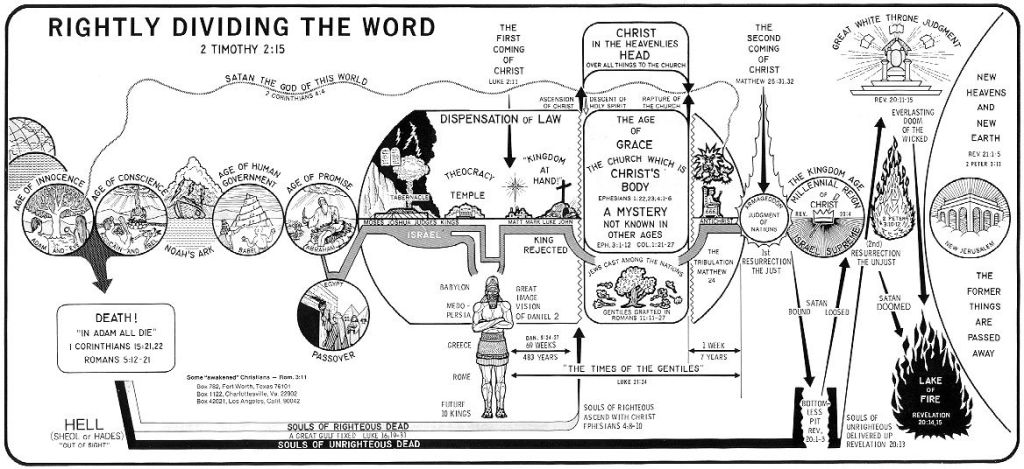
See what I mean? Sloppy. Now, that doesn’t mean it isn’t true, and I am not making any arguments here that it is or isn’t. But just so you can see where things are at in Dispensationalism’s timeline, we are right near the end. Israel becoming a nation in 1948 started the eschatological clock and we have an irrevocable appointment with the Tribulation any day now. This means according to the image above we are just before the “second coming of Christ” arrow.
Author Phillip Alexander summarized Dispensationalism predominance and titillating expectation of the end:
Dispensationalism was adopted as an article of faith by Dallas Theological Seminary (founded 1924), the most important conservative seminary in the States. It got into the bloodstream of conservative Evangelical theology, and now forms the ideological underpinnings of the powerful Christian Zionist movement in North America. These conservative, Evangelical Christians passionately believe that the founding of the State of Israel in 1948 is the fulfillment of biblical prophecy, and a clear sign that the Second Coming of Christ is at hand. And they believe that Christians have a duty to support Israel and help her achieve her God-given destiny in whatever way they can.
Phillip Alexander2
Some Numbers
Lets briefly look to some numbers. Polling back in the mid 1940s showed that Americans were overwhelmingly in support of the State of Israel being formed, and have always supported Jews over Arabs by no small amount. Stone sites many surveys from Pew and Harris in the early 2000s and summarizes the findings:
With respect to Dispensationalism’s impact on foreign policy, it is important to remember that a majority opinion is not necessary to have a significant impact. What can be gathered from these surveys is this:
Ibid
- Americans are much more likely to sympathize with Israel over Palestinians and other Arab nations.
- Americans are more evenly divided when asked if the government should support Israel over Palestine.
- A strong percentage believes that events in the Middle East are relevant to end times
scenarios.- A sizable minority believes in Dispensational concepts of the Rapture and Biblical
literalism in regards to other eschatological prophesies.- Approximately 32 million Americans ascribe to a Dispensational notion directly related towards Israel support, while another 35 million believe that Israel’s creation is a precursor for the Second Advent.
- Besides Jews, evangelical Christians show the highest and most consistent support for Israel.
According to a 2007 Pew poll, about one in three American adults believe Israel as important for the Second Coming of Christ, which gives much forward political momentum to her support. A 2002 Harris poll showed similar findings, where 43% of Americans supported Israel and 36% doing so specifically for Dispensational reasons. America’s population in 2002 was about 207 million, meaning roughly 89 million Americans supported Israel out of a Dispensational eschatological belief.
It is important to remember that a majority is not needed to influence public opinion; a small rudder can steer a Titanic. Anyone who thinks a majority is needed to significantly impact political decision makers has learned nothing from the LGBTQ+ fiasco and all the obsequious politicians looking to boost their position by their obeisance to the blue hairs. And they certainly do not make anything close to a majority.
Ok, we got some Dispensational understanding, some hard numbers, and the endemic mythology of Dispensationalism. Next we are going to take a quick, bulleted traipse through, oh, about three thousand years of history.
Brief History In Bullets
I will not make an attempt to lay out any detailed linear history of the land. It would be too hard, too long, and too much like reading a description of Jackson Pollock painting of a bowel resection. But here is the gist.
- 1300-ish BC – Israelites, led by Joshua, enter and possess Canaan
- 1000 BC – King David unites and rules over Israel from Jerusalem
- 957 BC – Temple built in Jerusalem by King Solomon
- 930 BC – Israel divided into kingdoms (Northern Kingdom) and Judah (Southern Kingdom)
- 722 – Assyrians invade the Northern Kingdom and exiles the Jews living there
- 586 BC – Babylonians invade the Southern Kingdom and exile the Jews there. Temple destroyed
- 515 BC – Jews return and rebuild the temple under leave of Cyrus
- 63 BC – Romans come in and take over, General Pompey takes over, Judea remains vassal state
- 70 AD – Romans destroy Jerusalem and the Temple
- 130 AD – Bar Kohkba Revolt. Jews almost throw off Romans. Romans are sick of it, rename Judah “Palestine”, which means “Land of the Philistines”, the Jews’ sworn enemy, as an insult to the Jews and to break their ties to the land.
- 7th century – Islam founded and takes over the entire area, and extend their conquest into northern Africa, as far as east as Spain and west to India.
- 1099-1291 – through a series of crusades, Jerusalem and the area is taken by Christians
- 1291 – Mamluks, a Muslim group, reconquers the area
- 1517 – Ottoman Empire, centered in Turkey, at the height of its power rules Palestine, which had always been a territory of an outlying empire.
- 1897 – Zionist movement begins
- 1917 – Balfour Declaration (see below), Jewish immigration increases, governance of Palestine falls to Britain.
- 1948 – Israel made a state. In their Proclamation of Independence, they invited Palestinians Arabs to stay in their homes and become equal citizens in the new state. In response to this, all surrounding Arab countries declare war with intention of annihilation. Israel fends off attacks, with one expectation that Jerusalem was split
- 1964 – Palestinian Liberation Organization (PLO) is formed. Still, up to this point in history there had not been, nor was at this time, any state called “Palestine.”
- 1967 – Six-Day war when the Arab nations of Egypt, Syria and Jordan decide to annihilate Israel again. Israel, through a series of preemptive strikes, actually takes ground, nearly tripling their size. The Arab League Summit meet and agree on the “Three No’s” in regards to the State of Israel: No peace, No recognition, No negotiation.
- 1973 – Yom Kippur War. Initiated by Egypt and Syria, Israel is attacked during their holiest day of the year. They suffer harsh casualties.
- 1979 Camp David Accords – Israel PM meets with the leader of Egypt and decide to give back Sinai, which was won in Six-Day War, in exchange for a cold peace. The Egyptian leader is assassinated by a jihadi cell.
- 1982 – Jordan expels Palestinians, who go to Lebanon in the north and start launching rockets on Israel. Israel retaliates and nearly takes the entire country, then withdraw under international pressure.
- 1987-1992 – Intifada (civil uprising) breaks out with widespread riots and terrorist attacks against Israel.
- 1991 – Israel PM starts negotiating with Yassir Arafat, a terrorist, to sign Oslo accords. PLO would recognize Israel right to exist. It fell apart quickly.
- 1998 Wye River Accords – Israel agreed to give more control over West Bank to Palestinian authorities in exchange for not being attacked by terrorists so much.
- 2000 – Camp David Negotiation – Once again, Arafat met with Bill Clinton and Israeli PM Barak. Barak offered everything. Israel would withdraw from 97% of the West Bank, 100% of Gaza and dismantle 63 Israeli settlements. Gaza would increase in size by 33%. In addition, Barak agreed to give “religious sovereignty” over the Temple mount to the Palestinians. This new Palestinian state would also have access to 30 billion in reparatory funds to the Palestinians. Arafat said no to everything for 14 days. In response, Arafat launches the second intifada, sending rockets and suicide bombers into Israel.
- 2005 – Israel withdraws completely from the Gaza Strip. The settlements, greenhouses and infrastructure left behind was summarily burnt to the ground by the Palestinians. The first government elected by the Palestinians in Gaza is Hamas.
- 2008 – Israeli PM Ehud Omer offers everything Barak did, and then some more. President Abbas of Gaza offers no counter proposal, just walks away from the table. Palestinians break ceasefire by launching rockets into southern Israel. Israel shuts it down.
- 2014 – Hamas launched 80 rockets into Israel after escalating tensions preceded by the abduction and murder of three Israeli teens. Israel shuts it down.
- 2021 – In response to legal decisions made by the Israeli Supreme court about moving six-families out of Israel’s annexed area, Palestinians stormed the al-Asqua mosque. Israeli troops responded with tear gas and rubber bullets. Hamas responded by launching over four thousand rockets towards targets in Israel. Israel shut it down.
- October 7, 2023 – Hamas slaughters over 1200 Israelis, raping, mutating and desecrating the bodies. They abducted over 200 civilians. This was not only televised, by celebrated by Hamas with a kind of orgiastic elation that turns the stomach. Even the Nazis had the decency to get drunk to forget their human atrocities. Hamas boasted of theirs on social media, even posting the recordings of killings on the victim’s social media pages.
As I said in the introduction, the history is complicated. Incidences could be found where Israel aggressed. But the often referenced statement is true: Tomorrow, if Palestine laid down their arms there would be immediate peace; if Israel laid down their arms, they would be summarily annihilated.
But what should be clear in this brief view of history is that Israel has a historic claim to a piece of land that far surpasses in length any other people group in history. Also, that Israel has been aggressed against by accumulated powers more numerous and vast than their own. Lastly, had Israel responded at any point with lex talionis type justice, many Arab people would have been decimated long ago.
In summary, I think this Doug Wilson quote says it best.
The pro-Hamas contingent complains that too much of Israel is occupied territory, by which they mean all of it, and that the Israeli government is insufficiently attentive to their demands, or to their rockets. My answer to this complaint is that they should have taken the territories that were offered them multiple times back when they were offered, they should not have used their territories to shoot rockets from, they should not have started so many wars and, having started them, should not have lost so many of them.
We shouldn’t over-analyze this
Doug Wilson
political actions
With a general timeline under our belts, lets look at a political timeline and see how tightly Dispensational theology has been woven into the modern history of Israel, and for what reasons.
We start in World War 1. The Central Powers are Germany, Austria-Hungary, Bulgaria and the Ottoman Empire (Turkey-ish area). As the war was winding down, it became clear that some of the area controlled by the crumbly Ottoman Empire was unable to govern itself. The League of Nations divvied up this land and placed their governance under Allied countries who were “entrusted to advanced nations who by reason of their resources, their experience or their geographical position can best undertake this responsibility” until “such time as they are able to stand alone.”1 Palestine and Jordan was given to the Brits.
British Foreign Secretary Arthur Balfour wrote in a letter to his friend that British governance in Palestine should include support for “a national home for the Jewish people in Palestine.”
“His Majesty’s Government view with favour the establishment in Palestine of a national home for the Jewish people, and will use their best endeavours to facilitate the achievement of this object, it being clearly understood that nothing shall be done which may prejudice the civil and religious rights of existing non-Jewish communities in Palestine, or the rights and political status enjoyed by Jews in any other country.”
Arthur James Balfour, in a letter to his friend Lord Rothschild
The British government included this sentiment into the body of the Mandates of the post-war Levant, now called the Balfour Declaration, and assumed control of the area in 1922. Likely this declaration was used by the British parliament to help rally Jewish sentiment, which was politically valuable at the time. Nevertheless, Balfour was sympathetic to Zionism because of his Dispensational beliefs, which translated into a political reality for Israel. Jewish return to their ancient homeland as a herald of the end of history was already an article of faith for many Christians, particularly in Britain. Dispensational winds were billowing Jewish sails.
Meanwhile, on the other side of the pond, Reverend William Blackstone was indefatigably hyping the idea of a Jewish state motivated by his Dispensational belief that the Millennium was upon us. He wrote a book called Jesus Is Coming about the end times that sold over 2 million copies. As early as 1891 he petitioned politicians to back the Jews returning to their homeland and submitted the petition to President Benjamin Harrison. This was an attempt to alleviate a humanitarian need as well as fulfill what he saw was second coming prophecy. Blackstone’s petition was also given to the growing Zionist Congress a couple years prior, and may possibly have influenced Theodore Herzl, the father of modern Zionism. Zionism is the Jewish nationalist movement that the land of Palestine belongs to the Jews.
Appeals were made to presidents Cleveland and Roosevelt by separate groups. Blackstone again petitioned Woodrow Wilson (worst president ever, rivaled only by the current administration), who was sandwiched between Blackstone’s prodding’s as well as the Balfour Declaration presented by the League of Nations. Requests for support of Israel was cornering him, and specifically by interested parties influenced by their Dispensational beliefs.
We should not take from this that Blackstone or Balfour or any other Dispensation-minded politician strong-armed any decision or could even be solely credited with American pro-Israel state support. Nevertheless, we see clear and active political movement in its direction. What we can say more certainly is that Zionism would not have experienced near the support it had without Dispensational backing. And this was in the early 20th century, before Dispensational eschatology was injected with rocket fuel by the formation of the Israeli state.
Anywho, when the League of Nations Mandates were passed in 1922, the vast majority of Palestinians were Arabs, though there had always been a Jewish representation in the land to some degree. In 1930s, the resurrecting Germany brought with it a hostility towards the Jews and spurred movement back towards Palestine where there was safety in the gathering exiles now returning home. The trickle of immigration became a flood and there was Palestinian kickback. In response, the British slowed the immigration of Jews into Palestine in hopes to mitigate the conflicts. The Jewish population in Palestine in 1917 was 10% and increased to 30% by 1947. These waves of Jewish immigrants set off a rash of violence.
It is important for the sake of fairness to see things from the Arab perspective. Unequivocally, the Jews had the historic claim to the land. But since the rise of the Muslim caliphate in the 7th century, Arabs have since enjoyed a majority population in the area. Then some hoity-toity Western infidels come along, assume governance of your land, and decide to give preference to the minority – a Jewish minority no less – who then call all their buddies who come in and buy up your land. What was presumed to belong to them was wrenched from their hands by foreign powers and they had little recourse. Whether or not their frustrations are legitimate or not, it is a reality that we must acknowledge to understand some of the current poo slinging.
Both Arab and Jewish populations continued to rise and in 1935 reached a fever pitch that set off an Arab revolt. The Brits sent in twenty thousand troops and the Jewish nationalists armed thirteen thousand of their own ranks, which stamped out the violence.
Through the interbellum period, Jews continued to pour in to Palestine; demands were made the immigration halt and the land sales cease. Jewish settlements were attacked. Arab leaders accused the Brits of not making good on the treaty, which the Balfour Declaration itself stated “nothing shall be done which may prejudice the civil and religious rights of existing non-Jewish communities in Palestine.” This led to the Brits reconsidering things. Maybe that hadn’t been all that fair. So they stymied Jewish immigration to only a certain number per year. This caused an equal and opposite reaction among the Zionist and Christian Zionists in the Britain and America, with demands for restriction to be lifted.
Deepening the worry, whispers circulated that the Balfour Declaration wasn’t all that central to the Mandate after all. Sympathies appeared to be shifting; American support was wavering. In America, Zionists movements such as the American Palestine Committee, pressed for continued support, which was headed by Zionist Neumann and included some heavy hitter politicians and Supreme Court judges. They released a statement dripping with Dispensational juice, “The fulfillment of the millennial hope for the reunion of the Jewish people with the land of its ancient inheritance, a hope that accords with Biblical prophecy…”2
During the World War 2, things in Palestine were surprisingly chill, which was nice, since the Brits were the only bastion against a certain madman with an ironic mustache fighting planet Earth. Afterwards, worldwide sentiment softened towards the Jews, learning of the holocaust and their bestial treatment under Nazi Regime. Jewish immigration proceeded at a fast pace into Palestine, increasing tensions once more.

The British new what a hornets nest they had on their hands. Thinking of their own national interest, it behooved them to have Arab support in the Middle East and opposed Jewish immigration. President Truman, however, supported the Jewish homeland idea. Britain was exhausted from World War 2 and wanted out so handed said hornets nest to the newly formed United Nations. Steps were taken to carve out the borders of an Israeli State. Things were divided up in a really wonky way at first, with patches of Israel here and there, but the borders rapidly changed over the next decade to something like the map to the right. The Jews were grateful just to have a state of their own. Everyone else pretty much hated it.
On May 14th, 1948 the British mandate on Palestine ended and the independent Israeli state was recognized, President Truman being the first head of state to do so. The extent to which President Truman was influenced by his religious beliefs in his support of the State remains questionable. However, at a speech to the Jewish Theological Seminary, he was introduced by a friend as “the man who helped create Israel.” To which Truman responded, “what do you mean helped create. I am Cyrus.”3 Cyrus was the Persian king who allowed the Jews to return to Jerusalem to rebuild the structures in the 500s BC.
Was Truman being cheeky? I sense some cheek. He was a Baptist, though no Zionist. What is fairly certain is that he was familiar with Dispensational beliefs as this was the dominant theological structure of the time. Truman backed Israel in opposition to many national leaders and even the majority of his cabinet. Indeed, history records him as a lone sentinel determined to man his post defending Israel despite a multitude of detractors both foreign and domestic. Stone says, “A realistic conclusion would be to say that Dispensationalism played an indirect, secondary role in Truman’s life, both in his Biblical understanding and his political affiliations. Dispensationalism’s impact on Zionism (Christian and otherwise) and Biblical interpretative methodology is undeniable.”
In the Dispensational camps, the return of Palestine to the Jews was – as Trump would say – heeyooge. Imagine if Greta Thunberg prophesied the Thwaites Glacier in Antarctica would melt and that melting would start the doomsday clock to climate demise, and then, unlike all the rest of climate predictions, it actually happened. I know, I’m taxing the imagination, but it would legitimize the climate movement to its detractors and vindicate the believers. The eyes of the world would turn and the ears would attend to the prophets to hear what comes next. For the Dispensationalists, the establishment of Israel was that moment. It was now the most legitimate eschatological position on the market, overshadowing all others.
In 1970, Hal Lindsay wrote his culture shifting The Late Great Planet Earth, codifying for the world the end times timeline. Israel’s statehood was the axe laid to the root of history. The end times fuse was lit and sizzling quickly to the dynamic events preceding the Second Coming. Revelation could now be filtered through world events to pinpoint where one could find themselves in the final push to the end. Author Haruki Murakami in his book 1Q84, captured the sentiment of this Western spirit convinced it was living in the last days, when he said, “Everyone, deep in their hearts, is waiting for the end of the world to come.”
Short prognoses sharpen priorities. Evangelicalism followed suit in the most logical fashion: frenetic evangelism, short-term planning, and abandoning all unnecessary political or social endeavors. Is it coincidence that the world population plateaued in the 1960s? My in-laws had a rapture clause in their will. No kidding. To be sure there were other factors influencing this sentiment – Cold War with a nuclear Russia, environmental destruction, communism, etc. But all of these were absorbed and interpreted through the only legitimate prophet on the street corner – the Dispensationalist. End times psychosis entered into the cultural bloodstream and everywhere erupted.

Hopping back to geopolitics, the formation of the State set off a series of attacks against the in 1948, ’56 and ’67. This last was a miraculous victory over the surrounding Arab nations that ganged up together and vowed Israel’s annihilation. Israel, through unparalleled espionage and bold military moves, not only held off their attackers but took a vast amount of territory. They gained the Golan heights, the Gaza Strip, parts of the West Bank and the Sinai peninsula. The bright green area on the map to the right shows the territory won by Israel in the Six-Day War in 1967. This providential victory further enshrined the Dispensationalists belief in divine protection – nay, the immortality – of Israel and buttressed the belief that the land was theirs by divine right.
Christian Zionists and Zionists were sympatico because they had the same goal but for different reasons. The Dispensationalists wanted the State because it was fulfilling prophecy and ushering in Christ’s second advent, which meant mass conversion of the Jews (and also probably mass destruction of many Jews, by the forces of evil…but, shhhh). The Jewish Zionists understood this, and likely stifled a few giggles, but Dispensational support meant it would help secure their goals too, even if there were obvious discrepancies in their civic and cultural values.
Morally, the Dispensationalist movement, comprised of biblically faithful evangelicals, and Zionist values ran afoul of each other. Israel was largely less conservative than the Dispensationalists, and remains so today. Culturally, Israel shared more in common with progressives than conservatives. However, Dispensationalists held their noses at this, believing that it was their duty to support Israel regardless of the moral stench of social liberalism. The idea was, if the state of Israel could be maintained, then this meant the eschatological clock was just about at midnight anyway, and no one will be around much longer.
Regardless of the moral dissonance, lobbying power in America increased. The American Israel Public Affairs Committee (AIPAC) (Formerly American Zionist Committee for Public Affairs) spent millions of dollars on political contributions from various pro-Israel PACs to Congressional members in order to achieve a continuing pro-Israel foreign policy. Though this was primarily comprised of Jewish Zionists, they also received support from Dispensationalist donations. The New York Times called the AIPAC “a major force in shaping United States policy in the Middle East.”4 They had close ties with the next figure to discuss, the late Jerry Falwell.
The Moral Majority, the Christian political movement begun in the 1979, founded by Falwell along with Tim LaHaye (co-author of dispensational fiction Left Behind Series) pulled a lot of Christian, and therefore Dispensational, political clout. The Moral Majority met with presidents, prayed with them, led prayer breakfasts, and were consulted on Biblical opinions of Israel. Political support for Jimmy Carter, though a believer, shifted to Reagan, because Carter seemed like he was getting too squishy towards Israel and sympathetic to Palestinians. Dispensational support was thrown behind Reagan and was credited with helping secure his election.
No Christian leader has done more to commingle Dispensational eschatology and politics more than Jerry Falwell. Falwell was a favorite of Israeli Prime Minister Menachem Begin, a passionate Zionist from an early age. When Begin ordered the strike against an Iranian nuclear reactor in 1981, he called Falwell even before Reagan to bolster U.S. support among his admirers. Oh, and Falwell also received a private jet from the Prime Minister.
In 1997, Falwell along with several other notable Christians, placed an ad in the NYT that read:
We, the undersigned Christian spiritual leaders, communicating weekly to more than 100 million Christian Americans, are proud to join together in supporting the continued
New York Times, April 18, 1997
sovereignty of the State of Israel over the holy city of Jerusalem. We support Israel’s efforts to reach reconciliation with its Arab neighbours, but we believe that Jerusalem or any portion of it shall not be negotiable in the peace process. Jerusalem must remain undivided as the eternal capital of the Jewish people.
Falwell claimed to speak for 100 million Christians. Actually, probably was more like 40 million. Still, in a country of 300 million, 40 is a sizable minority, and not to be trifled with.
Like many Christian Zionists, Falwell looked to Israel as a means to usher in the
Millennium. The Oslo Accords of 1993 were seen as an impediment to this goal, particularly the provision concerning Israel’s withdrawal from the Gaza Strip and Jericho. Falwell and others were displeased that Israel’s borders may contract. When Israeli Prime Minister Benjamin Netanyahu visited the United States in January 1998, he met with Falwell before meeting with President Clinton.
The many-hatted Falwell also had involvement with another evangelical pro-Israel lobbying group, Christians United For Israel (CUFI). In 2006, he gave a passionate speech at a CUFI organized banquet of over 3,000 evangelicals. In attendance were Republican senators, the RNC chairman, and the Israeli Ambassador Daniel Ayalon. Falwell’s speech provided the most fervor, “I will rebuke the State Department for any and every time it told Israel to stand down and show restraint,” for which a resounding applause followed. The next day CUFI attendees went to Congressional offices to lobbied support for Israel’s campaign against Hezbollah in Lebanon.
In 2007, Pastor John Hagee, whose Dispensationalism goes to eleven, and founder of CUFI, gave a keynote speech to rally support for Israel, “There are millions of evangelical Christians across America who consider the Jewish people the apple of God’s eye, who see you as the chosen people, a cherished people, and a covenant people with an eternal covenant that will stand forever. Ladies and Gentlemen of AIPAC, it’s a new day in America. The sleeping giant of Christian Zionism has awakened; there are 50 million Christians standing up and applauding the State of Israel.”5
Hagee’s CUFI also endorsed the Jerusalem Prayer Team’s petition to several administrations to finally make good on the Jerusalem Embassy Act, which would move the US embassy from Tel-Aviv to Jerusalem, further legitimating Israel’s statehood. The act was initiated by senator and one-time presidential candidate Bob Dole in ’95. The act passed 93-5 in the Senate and 374-37 in the House, an overwhelming majority. Dole endorsed the act specifically to gain fundamentalist Christian support. Relocating the US embassy to Jerusalem would be a sign to the world the US recognized Israel as a legitimate state. The document stated “History records that God deals with nations in accord with how these nations deal with Israel.” (Prayer team, 2007). The prayer team was endorsed by Lara and George W. Bush, Benjamin Netanyahu. President Donald Trump finally made the move that many presidents had tabled dating back a decade.
There is some solid evidence Reagan himself was Dispensational, if only vaguely so. In a conversation with the executive director of AIPAC, he said, “I turn back to your ancient prophets in the Old Testament and the signs foretelling Armageddon, and I find myself wondering if we re the generation that is going to see that come about.” This was leaked to the Jerusalem post then made its way to the Associated Press.
Concluding this portion we can see that Dispensationalism has permeated American culture for over a hundred years and entered into our future mythology through fictional works like the Left Behind Series. Leading the train of end times events is the return of Israel to her historic homeland. Americans see themselves as being contributors to this second greatest event in all of human history, the second advent of their Messiah.
Though many Americans may not be able to pass a test on Dispensational theology’s main points, it has leeched into Christian mainstream homes through fictive works like the Left Behind Series and other popular books. Author Gershom Gorenberg wrote, “the Left Behind books are giving millions of people an interpretive paradigm in which extreme views seem sensible.”6 The series has been read by one in six Americans, and one in three Republicans. It is eschatological candy. With few pastors assisting their congregations in how to understand end times theology, these books subtly school the Christian in a Dispensational – or pseudodispensational – theology; fiction fills the holes where truth is missing. It is not so much propaganda as it is prepaganda – a future history to budget for made more certain by Dispensational ties to Biblical prophecy and the encouragement to act accordingly.
Beliefs instigate action. Voters primed through a certain understanding of the world fill the voting booths and vote in accordance with their beliefs. But they first have to have something to vote on, and at some point, if we are talking about American foreign policy, we are talking about political leaders who introduce bills and voice support for Israel on a national level so that the voters can put them in office to do their will.
And can we not see, and even sympathize, with the excitement of Dispensational support for Israel? A vote for a politician who supports Israel is nothing short of a personal contribution to the end of history and the return of our Lord! What other time in history is like this, where a believer is in such a privileged position to throw their tiny weight behind the cogs of history to turn it that final tooth that strikes the clock midnight?
Stone concludes, “Events sponsored by Dispensational organizations for the specific purpose for promoting Israel are now a regular part of the political process. Their popularity draws exposure and thus political hopefuls see such involvement as an integral part of both campaigning for office and sustaining employment once elected. The creation of a forum for pro-Israel emotionalism is a contribution made possible by the continued proliferation of Dispensational theology.”
Dispensational support of Israel is largely predicated on the belief that Israel remains the chosen people of God. This certainly was true. But is it still? What if we find that they are not? Would this change our support of the State? Would it change the nature of the support? In this next section we will look at the biblical history of the claim for Israel’s election by God as His chosen people.
Covenant People
No Christian wants to find themselves fighting against God. Our business is to know God’s business to the extent He has revealed it to us. If God has a special plan for Israel that involves them inhabiting Palestine, as Dispensational theology claims, we all ought to get on board. But we oughtn’t overlook the vastly different destinations Dispensational belief terminates to the exclusion of other ways of reading the Bible. In this section, I want to compare these different views of God’s covenant with Israel with specific attention to who exactly constitutes “Israel” in light of the New Covenant made in Jesus’s blood.
A covenant is a solemn vow administered by a sovereign with attendant blessings and curses. They are the means through which God works with humans and humans interact with each other. So often do we encounter covenants in the Bible and in natural relations between mankind that one is suspicious God intends something by it. Its kind of like the Golden Ratio in that it shows up everywhere from seed heads to tree branches to spindly arms of galaxies. Families, marriages, governments, business partners, mortgage titles, and HOAs are covenantal, as is humans’ relation to God in general, and Christians’ specifically, by means of Christ’s blood.
A deeper understanding of covenants will help us hone in on Israel’s claim to the land. The main argument used to tie Israel to the land of Palestine is based on God’s promise to Abraham in Genesis 12, which was restated by Moses as he stood with the Israelites on the bleeding edge of the Promised Land.
God chose Abraham out of all the people on the earth to make a nation for Himself. Israel was chosen by God to be a light to the nations, to be his peculiar people belonging to Himself. God ratified this promise to the Israelites by covenant. Covenants are if/then agreements. If you will fulfill your end, then I will fulfill my end. The covenant can be broken by either party, and if breeched then the other party is off the hook for fulfilling their part.
Yahweh takes his covenant with Abraham one step further by “cutting a covenant.” In the ancient near east, this phrase refers to the means by which a covenant was ratified. Animals would be cut in halves straight down the midline and placed on either side of a channel. The blood of the animals would collect in the channel and each party would walk through the sloppy mess and solemnly swear the same gruesome fate awaited them if they did not fulfill their part. In Genesis 15, Yahweh had Abraham prepare the bloodbath, but when it came time for the trench walk it was only He that stomped through the congealed slush. The meaning for Abraham was clear: God would fulfill both His and Abraham’s part of the covenant. It was an unconditional promise to him and to his Seed.
This covenant was based on faith, not works, as there was no attendant command on Abrahams’s part to which he must obey. God did not require circumcision – the symbol of covenant keeping – until over a decade later. The covenant of circumcision was a different kind of agreement than the covenant of faith that God has just promised, which can be seen by the terms of the agreement (Genesis 17). Namely, that if any male was not circumcised, he would be cut off from the people. In other words, this covenant of circumcision by which a Jew was to be identified was conditional. Paul made it clear that circumcision was archetypical symbol for obedience to the the law of God written down by Moses (Galatians 5:2-3).
As Moses stood on the precipice of the Promised land, and after their forty year disobedience tour in the desert, he reminded them of their covenant promise to God and the stipulations under which the land was promised to them.
See, I have set before you today life and good, death and evil. 16If you obey the commandments of the LORD your God that I command you today, by loving the LORD your God, by walking in his ways, and by keeping his commandments and his statutes and his rules, then you shall live and multiply, and the LORD your God will bless you in the land that you are entering to take possession of it. 17But if your heart turns away, and you will not hear, but are drawn away to worship other gods and serve them, 18I declare to you today, that you shall surely perish. You shall not live long in the land that you are going over the Jordan to enter and possess
Deuteronomy 30:15-17
Blessings and curses were set before them, and in no uncertain terms; their time in the land was contingent on obedience to God. If they practiced detestable things then the land would vomit them out (Leviticus 18:28). And that is exactly what happened. The history of the state of Israel, after a brief golden age, is one of slow and steady decline, disobedience and disinheritance, despite many prophets sent by God attempting to turn the ship around.
Israel’s treatment of these prophets was a general dismissal of God’s warnings, with very few exceptions. They were beaten, abused, disregarded, laughed at, and otherwise ignored. In fact, this treatment of God’s messengers was so common it became something of a trope; Jesus sarcastically observes that it is not possible for any prophet to die anywhere but Jerusalem. Jerusalem, the very heart of God’s chosen people, was the kill box for God’s prophets (Luke 13:34).
Again, Jesus makes it clear in a parable of the wicked tenants (Matthew 21:33-43) the rotted heart of God’s once chosen people. After repeated envoys of servants sent by the vineyard owner to collect some fruit of the vineyard, he at last sends his son. The tenants scheme to keep the vineyard for themselves by killing the son.
This final rejection of God by the Jews was on display in their chilling declaration at Jesus’s trial before Pilate, when Pilate offered to let Jesus go free.
From then on Pilate sought to release him, but the Jews cried out, “If you release this man, you are not Caesar’s friend. Everyone who makes himself a king opposes Caesar.” 13So when Pilate heard these words, he brought Jesus out and sat down on the judgment seat at a place called The Stone Pavement, and in Aramaic Gabbatha. 14Now it was the day of Preparation of the Passover. It was about the sixth hour.c He said to the Jews, “Behold your King!” 15They cried out, “Away with him, away with him, crucify him!” Pilate said to them, “Shall I crucify your King?” The chief priests answered, “We have no king but Caesar.” 16So he delivered him over to them to be crucified.
John 19:12-16
The last word we have about the Jews in the Bible from the Gospels is the bone chilling admission from their leaders that they “have no king but Caesar.” And because of this, all the blood of the prophets from Abel to Zechariah – literally from A to Z – would be required of that generation (Matthew 23:35).
So we can see that the promise of the land which was held out by covenant to Israel was met with apocalyptic failure, and a just God will honor the terms of the agreement – they were vomited out of the land. This emesis happened in several installments, first with Israel (Northern Kingdom) to the Assyrians in the 700s, then Judah in the South to the Babylonians in the 600s. The promise of the land was tied to the command to love the Lord their God which the Jews transgressed, and that with a fair amount of flair. No lovey, no landy.
But the Jews continue to reject God by rejecting His Christ. Endless hours of video exists of orthodox Jews spitting on Christian missionaries, teaching their children to spit on them, and throwing rocks at them. “But of Israel He says, “All day long I have held out my hands to a disobedient and contrary people.” (Romans 10:21). As then, so today. Are these the actions of Gods chosen?
Currently, there are more atheist Jews (20%) in Israel than orthodox (19%). Seven percent of Israelis are Christian, but only 0.5% of that seven are Jewish, the others are Arab-Israeli Christians. In America, only one fourth of Jews believe in the God of the Bible, and Messianic Jews make up about 8% of the entire Jewish population. The overwhelming majority of Jews reject Christ. Those are the facts. Israel does not love God. The covenant is broken and any claim to the land based on that promise is forfeit by Israel’s covenant breaking.
Jesus made clear, rejection of him is rejection of the Father (Luke 10:16-23), and John said no one who denies the Son has the Father (1 John 2:23).
Dispensational theology maintains that ethnic Israel continues in covenant in unbroken relationship as God’s chosen people despite all of this covenant breaking, which means the promise of the land still stands; God remains faithful even if the Jews were, and are, not.
They may have a point. God’s covenant with Abraham was unconditional. So what that the Jews reject God, maybe we just need to chill and be more patient? Maybe God is just corralling all the Jews into one spot so he can pour some salvific sugar on them all? Or what if – and this is a terrifying thought – God’s promise has failed?
Children Of Promise
If we are asking these questions, we are in good company – the Apostle Paul was rolling this around too. Most of the Jews he evangelized rebuffed him, stoned him, or riled up a lynch crowd. His treatment by God’s covenant people got him pondering the same questions of the exact relationship between Israel and God. He lets us in to his thought process.
I am speaking the truth in Christ—I am not lying; my conscience bears me witness in the Holy Spirit— 2that I have great sorrow and unceasing anguish in my heart. 3For I could wish that I myself were accursed and cut off from Christ for the sake of my brothers, my kinsmen according to the flesh. 4They are Israelites, and to them belong the adoption, the glory, the covenants, the giving of the law, the worship, and the promises. 5To them belong the patriarchs, and from their race, according to the flesh, is the Christ, who is God over all, blessed forever. Amen.
Romans 9:1-5
What’s the deal? Don’t the promises and covenant belong to Israel? Didn’t the Christ come from their stock? Yet everywhere they were rejecting God. Does this mean God’s word has failed? If it has, if God reneged on His promise, this is bad news for the universe. But Paul tells us something more glorious is at work. Things weren’t as they seemed. Behind the scenes, God was busy weaving a mystery that the light of Christ revealed.
But it is not as though the word of God has failed. For not all who are descended from Israel belong to Israel, 7and not all are children of Abraham because they are his offspring, but “Through Isaac shall your offspring be named.” 8This means that it is not the children of the flesh who are the children of God, but the children of the promise are counted as offspring.
Romans 9:6-8
This passage is the theological equivalent of that scene in The Sixth Sense when the kid on the bed tells Bruce Willis he has been dead the whole time. It retroactively shed light on the whole mystery and everything clunks into place. Except with this mystery, no one saw it coming – I don’t care if your uncle said he knew it all along.
It wasn’t that God’s word had failed, rather the ground gave way revealing a deeper mystery running under the feet of the Old Testament all along. Just as “failure” of the crucifixion was revealed to be a great victory, so the perceived “failure” of God’s word unveiled the deeper magic that was planned from the beginning. The true children of Abraham do not share the genetics or culture or phallic amendment of Abraham, but the faith of Abraham.
“For no one is a Jew who is merely one outwardly” Paul explains, “nor is circumcision outward and physical. But a Jew is one inwardly, and circumcision is a matter of the heart, by the Spirit, not by the letter.” (Romans 2:28)
Children of promise, those who have a circumcised heart, who share the faith of Abraham, who receive the Son- these are the chosen people, the children of the new covenant. This is God’s fulfillment of his unconditional covenantal promise to Abraham all those years ago. Paul tells us this promise of God was not only made to Abraham, but also to his Seed, who is Christ.
Now the promises were made to Abraham and to his offspring. It does not say, “And to offsprings,” referring to many, but referring to one, “And to your offspring,” who is Christ.
Galatians 3:16
Through Christ we also become sons and heirs, “And if you are Christ’s, then you are Abraham’s offspring, heirs according to promise (Galatians 3:29).
Follow the allegory. Not all Israel is Israel. It is not the children of Abraham who share his circumcised penis that are true Israel, but the ones who share his circumcised heart – the heart of faith. The outward symbolism of the former was just a big analogy, a story telling motif, to exemplify the truer, spiritual change of the heart. Gentile salvation was not a contingency plan when Israel rejected God. It is not as though a Jew is a biological son, while a Gentile is a step child. A true Jew was of the faith of Abraham and that was always plan A all along, this included members of the ancient Israelites. In other words, there’s never been a causal connection between being born of Jewish stock and being a child of the promise.
Paul goes through great pains to explain this to us, and he uses Abraham’s two sons as archetypes of two sets of people: children of the the promise, and children of slavery. After God’s promise of an heir came to Abraham, he took a look at his limp body and Sarah’s dusty womb and decided he would help God out a bit by taking his wife’s slave Hagar and having a child through her. This was Ishmael, the son of the slave woman. Abraham pleaded that God would do him a solid and just make Ishmael the heir (Genesis 17:18). God said, no, that is not how we are going to do this. His heir will come through the promise, through Sarah, which was impossible. Abraham knew it. Sarah knew it. And God knew it.
He did this to preempt boasting and show that salvation comes not from man’s willing or running, but through God’s power alone. He will not leave even a crack open that would allow for human boasting. Sarah conceived and gave birth to Isaac, the son of promise, the son of faith.
Pharisees tried to impress Jesus with their Abrahamic pedigree. He laughed through his nostrils, “Big deal, God can makes children of Abraham out of that hunk of granite over there” (Matthew 3:9).
A child of the flesh doesn’t just mean a child that is born of natural human relations, but by man’s will, innate abilities, fleshly powers. There was nothing supernatural about the birth of Ishmael. Isaac’s, on the other hand, was miraculous. Sarah was old, post menopausal. His birth was supernatural, a feat unable to be produced by man’s will or abilities – just like faith. What Paul is saying is that the true Israel is a supernatural creation of the sovereign God doing what no human being can do.
Physical Jews who were descended genetically or culturally from Abraham, if they continue under the law, are actually like Abraham’s children of the slave woman, Hagar. It is the children of promise – the children who share the faith of Abraham, who are the true Israel. God has not forgotten his promise to Abraham that his descendants will be like the stars in the sky, and he is in the process of making good on it. Who are those? They are the ones who have faith in the Son of God, Jesus the Messiah. This is the same Messiah that the Jews murdered. Murdering the Son of the King with whom you swore covenant obedience is decidedly a breaking of that covenant.
Gentiles are not replacing the Jews, as if none of them are allowed to the party anymore, an idea referred to as “replacement theology”. No, to both Jews and Gentiles the offer of salvation is held out equally as freely by faith to all who believe. These are the children of God, the chosen people, the elect. To miss this glorious mystery is to miss one of the most profound and important truths of the Bible, which Dispensational theology fumbles cosmically.
The track switch is missed back in Nebraska, and so the Dispensational locomotive ends up in Long Beach instead of Portland. But come to think of it, a more appropriate description of the track switch given their belief in an imminent eschaton may be that the train has turned onto one of those spur tracks that terminates in a hundred yards into a in a pile of railroad ties.
An Agnosticism Admitted
Romans 11 has a curious caveat. Paul does say that all Israel will be saved.
Lest you be wise in your own sight, I do not want you to be unaware of this mystery, brothers: a partial hardening has come upon Israel, until the fullness of the Gentiles has come in. 26And in this way all Israel will be saved, as it is written,
“The Deliverer will come from Zion,
he will banish ungodliness from Jacob”;
27“and this will be my covenant with them
when I take away their sins.”28As regards the gospel, they are enemies for your sake. But as regards election, they are beloved for the sake of their forefathers. 29For the gifts and the calling of God are irrevocable
Romans 11:25-29
Does this undermine my entire argument? No. Because clearly the covenant that tied Israel to the land has been broken by their disobedience. But this does not mean that God is not going to do some miraculous work among them to bring a vast majority to a saving knowledge of Jesus Christ. Indeed, that seems to be what Paul is saying. What or how or by what standard God will save this group of people, I haven’t the foggiest. Is it those of the bloodline of Abraham? Orthodox Jews only? Anyone who wears Levi jeans? We can’t see into that promise, but only stand on the outside and trust that God knows how he is going to split the hairs
This magnifies the mercy of God. Israel crapped the covenantal bed and lost their home. But God is rich in mercy and one day will turn the hearts of the Jews back to him and give them a nice plot of land in heavens where they will walk with Jesus Christ.
Conclusion
The events of October 7th were beyond heinous. It was a mini-holocaust, perhaps even worse in its atrocities because of the public boasting and glorying in the violence. No thinking person with their head on straight can actually draw any moral equivalence between the actions of Palestine and Israel. The wide spread American support from Hamas that we have seen on the college campuses and large cities is an abomination and can only happen in a country where envy and sour love inbreed.
I want to be clear, in this current conflict, the only reasonable moral position is to side with Israel and allow the country to seek and destroy the cowardly aggressors who raped, slaughtered and televised their wickedness. None of the above analysis of Israel’s history, nor their covenant breaking, ought to be taken to mean they should be evicted from the land, or that they are some Marxian oppressor, or colonizer, or any other of those names meant to paint a target on their backs. Neither does it means that I do not think the Jews have a claim to the land of Israel. They do. I believe it is theirs, but for geopolitical reasons applicable to any other country in boarder disputes to be handled with wisdom and justice.
However, it seems clear to me that my inherited assumptions that the land belongs to Israel by divine right were misplaced. The chosen people of God, the true Israel, are those of the faith of Abraham, those who trust in Christ by faith through grace – Christians. The gospel is open to all who believe, both Jew and Gentile. The rights of nations and where boundary lines are drawn should be decided by the principles of justice, not claims to divine right.
What this means practically for Christians is that we ought not hold Israel up as some kind of alternate system of values, or think that God winks at their rejection of Him, or that we ought to weigh their deeds with a weighted scale because of their historic election. They need Jesus as does everyone in Palestine. The mutual slaughter of sons will continue until a time as they receive the slaughter of God’s only Son and then can peace be made.
References
- Covenant of the League of Nations, Article 22 (1919, June 28). Peace Treaty of Versailles, Geneva, Switzerland.
- Alexander, P. (2018). Why did lord Balfour back the Balfour Declaration? Jewish Historical Studies, 49(1). https://doi.org/10.14324/111.444.jhs.2017v49.050
- Moshe Davis, “America and the Holy Land: A Colloquium,” American Jewish Historical Quarterly 62 (September 1972)
- Shipler, David K. (July 6, 1987). “On Middle East Policy, A Major Influence”. The New York Times.
- John Hagee. AIPAC Policy Conference 2007. March 11, 2007.
http://www.aipac.org/Publications/SpeechesByPolicymakers/Hagee-PC-2007.pdf (21 Sept 2007) - Gorberg, Gershom, 2002 ‘Intolerance: The Bestseller’. Rev. of Left Behind series, by Tim LaHaye and Jerry Jenkins, in American Prospect (23 September): 44-47

 Thought Butter