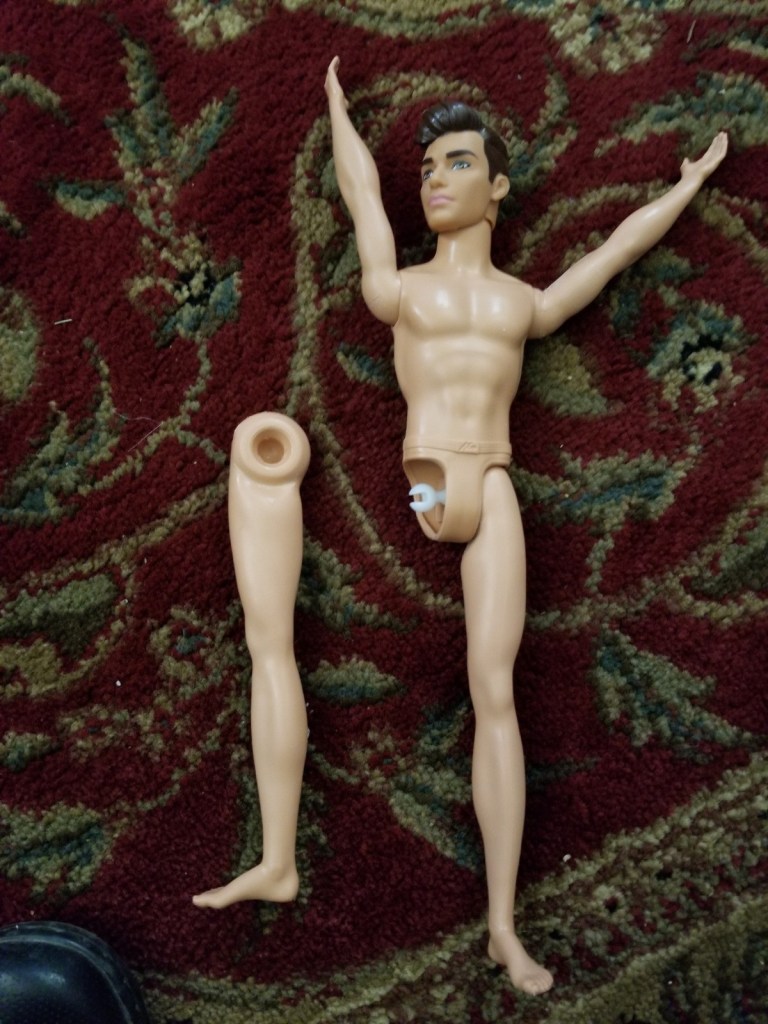
The title says most of what I mean to get across. But let me give you a backstory of the limb, to whom it was once attached, how it became detached, and then I will have some spiritual yummies to share.
At no set intervals I can figure, a train runs through downtown Fort Collins several times a day. It does seem, however, that these times are correlated with whatever time I am late for work. Often the train needs to pick up some more cars or unload an engine or whatever, and comes to a halt right in downtown, cutting the east from the west. Traffic backs up for blocks, car engines are turned off, cell phones are pulled out, candy is crushed.
Well, this particular train was taking its sweet time doing whatever the hell it was doing, and frustrated westbound pedestrians, not about to let a few thousand tons of iron get in the way of them and some pour over coffee, began hoping the knuckles of the train cars.
Among this crew was a woman in her 60s, who allegedly had a touch of agoraphobia. She decided to hop the knuckles too. I don’t know how limber she was; I can’t imagine she was too familiar with the motion of climbing over train knuckles, which is not unlike mounting a small pony on one side, then dismounting on the other.
From what I figure, after she got one hip slung over the steel and was straddling the knuckles, the engine tugged and jolted the train cars taut. This jolt knocked her to the pavement, her left hip traversing the track, while the train – slowly – orphaned the leg at the hip. It also mangled her arm, but as the arm was still (technically) attached to her body, it does not meet the criteria described in the title.
So there she lay in a puddle of life, separated east from west, the world getting dark.
When the ambulance screamed onto the scene, they found themselves on the east side of the tracks, her exsanguinating on the west, and the train snailing up the street straddling a shoeless, bodiless leg. The men in blue, pacing powerless on the other side of the tracks, watching that blood spurt merrily, assumed she would be drained dry by the time the train got done getting out of the way, and called in a Code Black to dispatch.
Well wouldn’t you know, once the medics were able to get to her they found her breathing. So they tossed her and her pieces in the back and hauled to the nearest emergency room, lights blazing, sirens howling.
The train, it was told, rattled on northwards towards Cheyenne, unremorseful and unrepentant.
As the gurney bustled through the ambulance bay, that she was missing a leg was my first observation. Trailing behind the team of paramedics was a firefighter carrying the affected limb by the thigh, a look of petrifaction on his face that could steal the soul right out of a kitten at a hundred yards.
Traumas such as these attract the junkies. Soon the trauma bay was filled with a feeding frenzy of OR and ER nurses, trauma surgeons, techs, anesthesiologists, ICU nurses, all swarming the patient, clamping this, poking that, cutting off clothes, all while furtively scoping out the gore. From my viewpoint, I can tell you there was a preponderance of crimson.
I have never been skittish around body parts. When there is a hole in a person I am of the ilk who wants to see inside of it, poke around a bit with a scholarly interest. It’s the smell that gets me. Fresh wounds waft a metallic taste in the air, a ferric bouquet of raw meat that sits in the sinuses and won’t budge. It’s a smell that never belongs, like an unwelcome guest to the party. Turns my stomach. The room was filled with it.
As the primary trauma nurse it was my job to send some labs to see exactly how many red blood cells she may still have rolling around in her veins. Through the din, I made my way to the counter in the back of the room where the lab stickers print off to find it cluttered with papers, medical equipment and computer screens, none of which I needed. I began double fisting objects and tossing them to the side to get to the lab stickers. Even the most experienced nurse gets the adrenalin shakes in these situations, the field of vision shrinking to the functional center.
Then I grabbed the cold pale flesh of a 60 year old leg. It was wearing a pink sock.
To say that I recoiled is a good word to use here. Recoiling is an interesting phenomenon, one which I don’t often have the displeasure of experiencing. Just as the leg reflexes when the doctor taps it with a tendon hammer, the stimulus not passing all the way up to the brain, but reacting to the stimulus, so recoiling is a reflex of the soul when it encounters something gruesome.
I dropped the leg, jumped back and some vocable escaped which sounded something like “GEEH,” and the sober part of my mind remarked on what a unique sensation that was just then.
After recovering, I sent the labs and the gaggle of staff scampered off to the operating room with the patient. I was left alone in the room with the leg propped against the computer screens and bent at the knee, foot poised like a periscope, taking it all in. Strange place to put a leg, I know, but we don’t have like a leg bin or anything we can put stuff like that in. Nor do I want to live in a such a world where we have so many amputated limbs it necessitates an entire bin.
That’s what happened.
So what kind of thought can I wring from this experience? Recently, I have had death on the mind. In particular, what is it? To limit death to the physical is to run the same risk as the captain of the Titanic and only see the tiny portion of the iceberg poking its head out from the cold sea. What is death in itself? It is separation, a cleaving.
Perhaps the limb story was a bit on the nose, but as I think about the myriad ways death intervenes in our lives, substituting the word separation for death gives our experience a robust quality and explanatory power.
Sin gives birth to death and divides. After the fall, Adam and Eve hid from God and each other, the earth bore thorns instead of fruit, animals were estranged. Even within themselves I believe they felt the jarring disjointing of body, soul and spirit. Then, hundreds of years later, the body and soul were separated at the end of their life. The sting of death is separation.
This concept is ubiquitous in our lives. What if, if only for a thought experiment, we swap the word death for separation, how would we see the black tendrils of death in our bodies, minds, relationships, country and world?

 Thought Butter
As always, your article is of highest quality and had me on the edge of my seat, Tim . You always give me great things to mentally “chew ‘ on.
LikeLike